
Where does your pilot stand? Answer 20 questions and see your score on the page: AI production readiness scorecard.
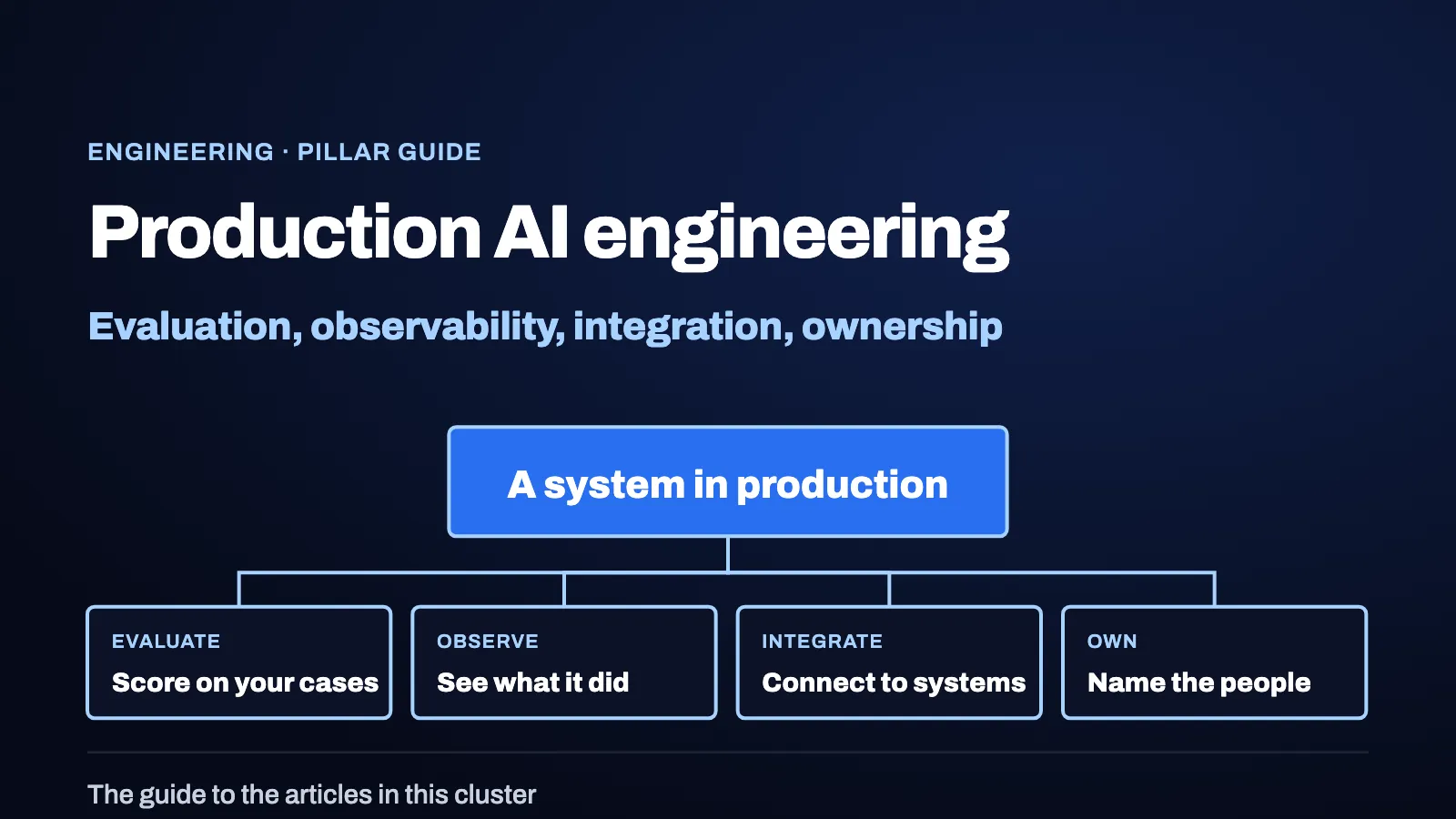
Production AI engineering is the work that takes an AI system from a pilot that works to a system that runs inside your operation. It covers five things that a pilot can skip and production cannot: how the system is evaluated, how it is observed, how it connects to the systems you already run, how it is controlled, and who owns it. This guide summarizes each and points to the article that goes deeper.
Production AI engineering is the set of decisions and controls that let an AI system run in your operation, be explained when questioned, and be owned by named people.
It is written for operators and technical owners. You may have a pilot that has stalled, or a system that is about to go live. Read it in order, or jump to the part you need. Each section ends with the article to read next. For the wider path, see AI pilot to production and why AI pilots stall.
Key takeaways
- Define production first. One page that says what the system may do, how it is scored, and who answers for it.
- Evaluate on your own cases. Keep the test set after go-live.
- Observe what the system did. Health signals alone can stay green while an answer is wrong.
- Integrate on purpose. Decide access, identity and failure behavior for each connected system.
- Control by consequence, and name owners. Approval before irreversible actions, supervision for reversible ones.
What is production AI engineering, and what does “in production” mean?
In production means the system runs in your operation, on real data, for real people, with someone answerable for it. It is not a date on a calendar and it is not a model that passed a demo. It is a state you can define in advance.
The definition fits on one page, signed by the business owner and the technical owner before go-live.
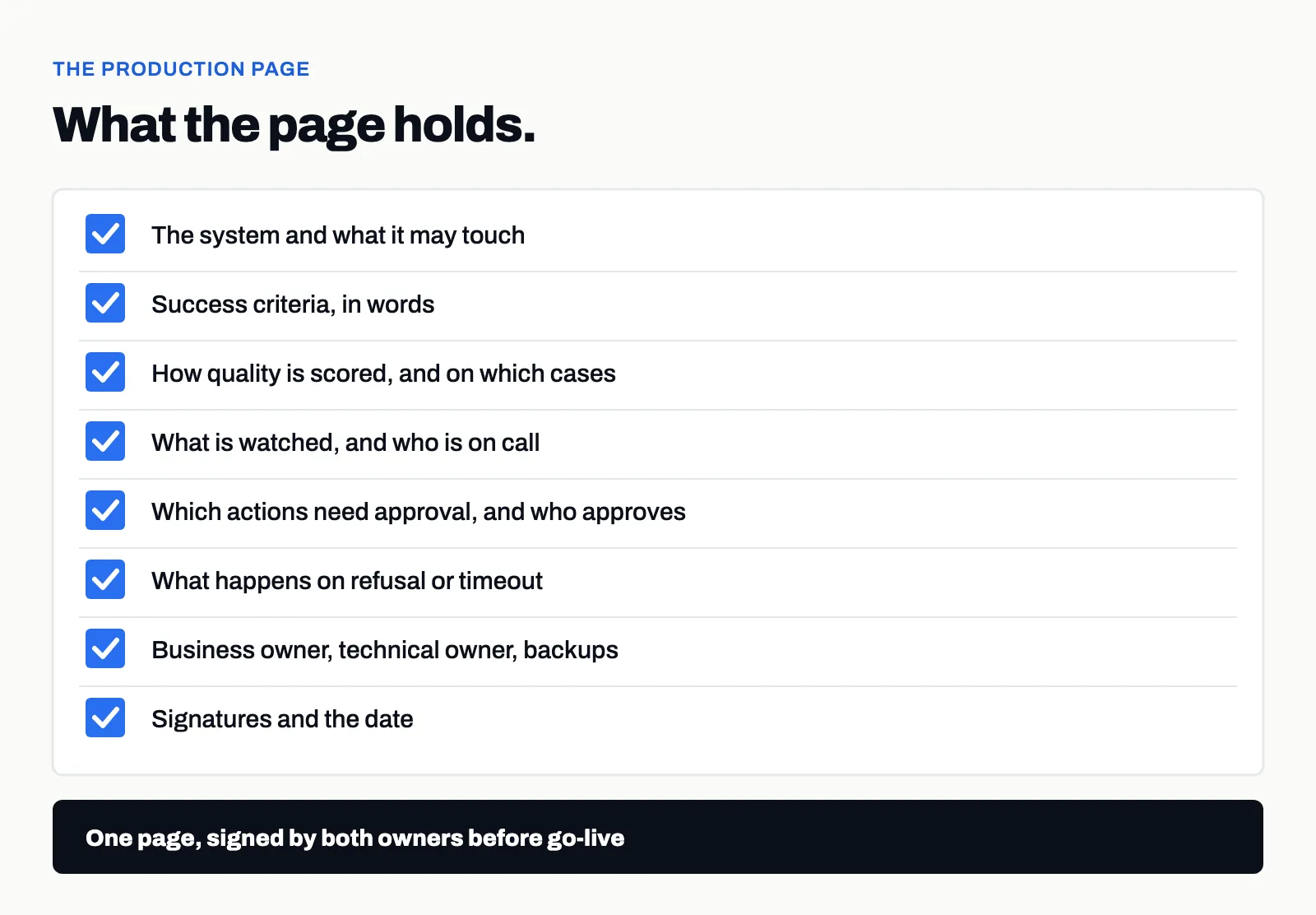
Writing it forces the open decisions into view. Our article on defining production for an AI system gives the structure. A pilot stalls when those decisions stay open.
How do you evaluate an AI system?
Evaluation scores the quality of what the system produces, on cases you choose. An eval is a test with a defined input, a defined way of judging the output, and a score you can compare over time. Without evals, a change to a model, an instruction or a tool is a guess.
Three habits help. Build the test set from your own operation, not from generic examples. Score before go-live to decide whether to ship, and keep the same set afterward to catch drift. Re-run it whenever anything changes.
For the definition and the scoring methods, read what LLM evals are. For systems that take actions, the path matters as well as the result: how to evaluate AI agents covers scoring the steps and the outcome, before and after go-live.
How do you see what the system is doing?
Monitoring watches signals chosen in advance, such as speed, errors, availability and cost. Observability keeps enough detail about each request that you can ask a new question later: what came in, what context was retrieved, which model and instructions ran, which tools were called, and what came out.
The two answer different questions. Monitoring says that something is wrong. Observability helps you find why. An AI system can return a fluent, wrong answer with a normal status, normal speed and normal cost, so health signals alone can stay green while quality drops.
For the vocabulary behind this, the OpenTelemetry observability primer describes observability as the ability to understand a system from the data it emits, which is the idea applied here to an AI system. The comparison, with an example of one request seen both ways, is in LLM observability vs monitoring.
How do you integrate it with the systems you already run?
A pilot can run on an export or a test account. Production has to reach the systems your people use, with real permissions. For each connected system, decide what the AI may read, what it may write, who it acts as, and what happens when the system is slow, down or says no.
Apply least privilege: the minimum access the job needs, under a named service role with a named owner. Give each system its own row on one page, and have the owner of that system read it. Rehearse the failure cases on purpose before real customers see them.
The five decisions, with an example page and a section on legacy systems that offer no clean way in, are in integrating an AI pilot with the systems you already run.
Which controls does an AI system need?
Sort the actions it can take by consequence.
- Reads need no gate.
- Reversible actions inside your operation can run with sampled review after the fact, or with supervision.
- Irreversible or external actions, such as paying, deleting, changing an access right or writing to a client, wait for a named approver.
Two control models follow. In the loop, a person confirms before the action runs. On the loop, the action runs and a person supervises, with a way to stop and a way to undo. The choice follows the consequence of the action, and one system can use both. The comparison is in human in the loop vs human on the loop, and the design of the approval step itself, including who approves, what they see and what happens on refusal or timeout, is in approval gates for sensitive automated actions.
The principle behind these controls is described in AI trusted by design, and on our trust page.
How do you change a live AI system safely?
A change to the model, the instructions or a tool is a versioned decision, not an edit. Each of them can change what the system does, so each gets a version, a reason and a name.
Use the same steps every time:
- Write down the change and why. One line in the change record, with the person who asked for it.
- Re-run the test set. The cases built from your own operation show whether the change helped, did nothing, or broke something that worked.
- Roll out to a small share first. Send a limited part of the work through the new version and compare it with the old one before you widen it.
- Keep the previous version. If the records show a problem, you can go back without rebuilding anything.
- Name who approves. The technical owner proposes and the business owner approves any change that touches an action with consequences.
The order matters because a quiet change is the hardest to explain later. When the records show a different answer than last week, the first question is what changed, and the change record is where the answer should be.
RAG or fine-tuning?
The question can arrive early in a project, and it helps to start from the problem. If answers must reflect facts that change, retrieval can supply the current content at request time. If outputs must follow one form or style, fine-tuning can change the model’s behavior. A system can use both, and each needs its own test.
Each has production work. Retrieval needs good content, freshness, and permissions so people only retrieve what they may see. Fine-tuning needs training data you can account for, versions, and a regression check on every new version. The full comparison, including effort, is in RAG vs fine-tuning for production AI.
What changes when the system is an agent?
An agent chooses and calls tools to reach a goal, so its output is an action in your operation and not only text for a person to read. The review step that a pilot gets for free, a person reading the answer, is no longer in the path unless you put it back.
Five decisions matter more: which tools it may call, which permissions it holds, which actions need approval, how you evaluate the steps and the result, and who answers for it. They are set out in agentic AI from pilot to production. The risk of giving an agent more functionality, permissions or autonomy than its job needs has a name in the OWASP GenAI project, LLM06 Excessive Agency, and the controls above are the practical answer to it.
NIST’s AI Risk Management Framework is a useful neutral reference for the surrounding discipline. It organizes AI risk work in four functions: govern, map, measure and manage. The topics in this guide sit across all four.
How do you review a system after go-live?
Go-live is the point where the evidence starts, not where the work stops. Review on a fixed rhythm that the two owners choose and write on the production page.
Two reviews do the core of the work. The first is sampled scoring of real requests: pick a sample of what the system handled, score it with the same method as the test set, and add the cases that surprised you to the set. The second is an owner review of what people changed or refused: look at the edits reviewers made, the approvals that were declined, and the requests the system could not handle. These show where the system and the operation disagree.
Decide in advance what moves a control. Repeated clean results on a reversible action can justify lighter supervision. A wrong action, an unexplained answer or a new kind of request can justify tightening a control, adding an approval, or pausing the action until the cause is understood. Record each decision with a name and a date, so the page stays true.
Who owns the system after go-live?
Two named owners, each with a backup. The business owner answers for the outcome and decides which actions need approval. The technical owner keeps the system running, handles incidents, and makes changes safely. A change to the model, the instructions or the tools is a decision with a name on it, because it can change what the system does.
Write the names on the page that defines production. When an owner changes role, the backup takes over and the page is updated. A system with no named owner after launch does not yet have one. The article on who owns an AI system after go-live gives a template for the page and the questions to settle before launch.
How do the topics fit together in one example?
Take a generic case: an AI agent that answers customer requests. It reads an order record, drafts a reply, and can send it. This is an illustration, with no real client or figures.
On the production page, the owners write what the agent may touch and what counts as a good outcome. Integration decides that the agent reads the order system through a read only service role, and drafts into a queue. Controls sort the actions: the read needs no gate, the draft can run on the loop with sampled review, and the send to the customer waits for a named approver, with a timeout rule. Evaluation scores the agent’s tool choices and replies on cases from the team’s own history. Observability keeps the input, the retrieved context, the model version and the outcome for each request, so a wrong reply can be traced to its source. Ownership names a business owner for the outcome and a technical owner for the system, each with a backup. Each decision sits in one place, and the others rely on it.
What goes wrong without these decisions?
- The pilot ran on an export. The first real connection is also the first real test.
- Only the final text was tested. A wrong tool call along the way shows up in production.
- Health signals stay green. Nobody has the records to see why answers got worse.
- The gate has no timeout rule. The first unanswered approval stops the process, or someone bypasses it.
- A change has no approver. The system’s behavior shifts and nobody decided it.
- The owner moved on. There was no backup, so there is no owner.
A short glossary
- Eval: a test with a defined input, a way of judging the output, and a score.
- Trace: one connected record of a request: input, context, steps, output.
- Retrieval (RAG): supplying the model with relevant content at request time.
- Fine-tuning: training a model further on examples so that its behavior shifts.
- Agent: a system in which a model chooses and calls tools to reach a goal.
- Approval gate: a point where a sensitive action waits for a named person to approve, edit or refuse.
- In the loop, on the loop: a person confirms before the action, or supervises while it runs.
- Audit trail: a chronological record chosen so that someone else can reconstruct a decision.
In what order should you do this?
The topics depend on each other, so the order matters.
- Define production. The page comes first, because it names what the rest has to serve.
- List the actions and sort them by consequence. This sets the controls.
- Connect the systems on purpose. Access, identity and failure behavior per system.
- Build the test set and score. From your own cases.
- Turn on observability for the sensitive workflows. Decide what is kept and who can read it.
- Name the owners and backups. Sign the page.
- Review on evidence. Loosen or tighten controls using what the records show.
Where does each article fit?
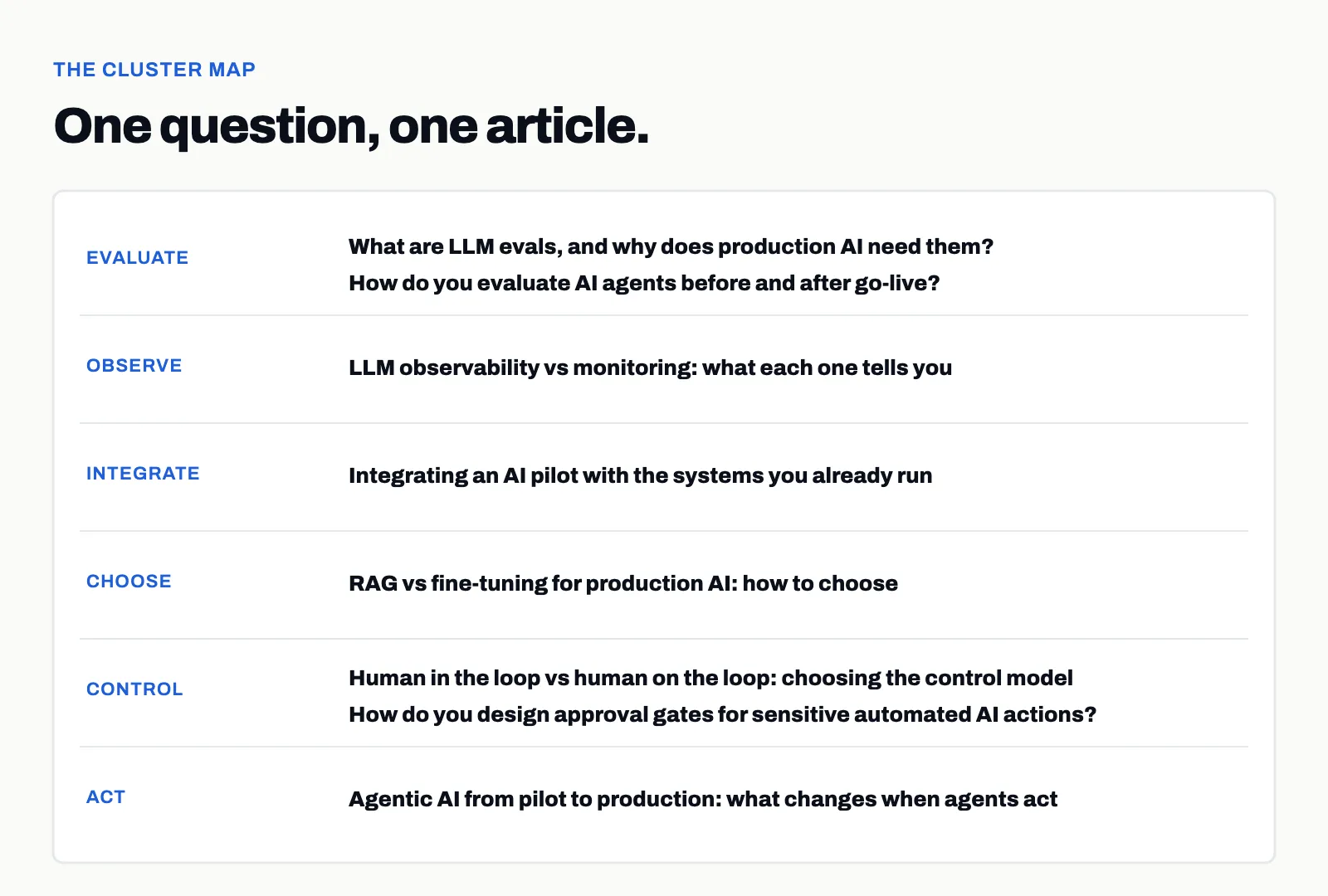
Use the map to find the next article. We update this guide when a new article in the cluster ships.
What should you do next?
Take one AI system and write the production page for it. List the actions it can take, sort them into tiers, and name the owners. The gaps you find are your next decisions.
Our forward-deployed engineers work directly with your business and technical teams to take systems from pilot to production. Read about forward-deployed engineering.
Bring us the problem, not the specification. Book a call. One call is enough to know whether we can help.
Questions
- What is production AI engineering?
- The engineering work that takes an AI system from a pilot that works to a system that runs in your operation: how it is evaluated, observed, integrated with your systems, controlled and owned.
- What should be decided before an AI system goes live?
- What production means for this system, how quality is scored and on which cases, what is watched and who is on call, which actions need approval, how it connects to your systems, and who owns it.
- How is evaluation different from monitoring?
- Evaluation scores the quality of outputs against cases you define. Monitoring watches signals such as speed, errors and cost. A system can pass monitoring and still give a wrong answer.
- Do I need observability for every AI system?
- Start with the sensitive workflows. Keep enough detail about each request to ask why the system did what it did, and agree who can read it.
- Who should own an AI system in production?
- A named business owner who answers for the outcome and a named technical owner who runs the system, each with a backup, written on the page that defines production.
- Where should I start?
- With one system and one page: define production, list the actions it can take, sort them by consequence, and name the owners.
Bring us the problem.
Book a call