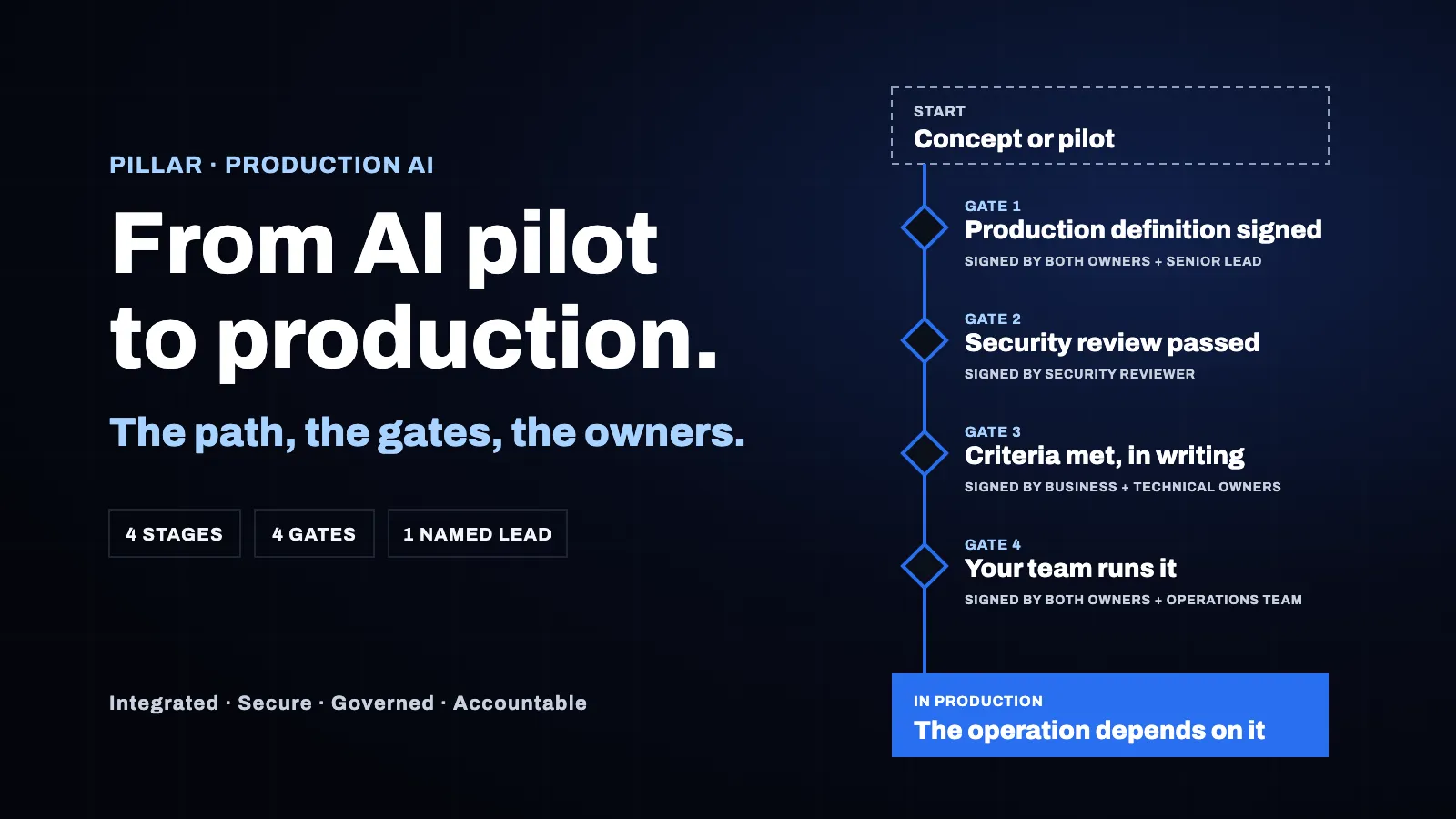
Moving an AI pilot to production takes four stages: diagnose, build and integrate, prove it alongside the current process, then go live and hand over. Each stage closes with a written gate that named owners sign, and one senior lead stays accountable for the whole path.
AI pilot to production is the path that takes an AI system from a working test to a system the operation depends on, through stages that close only when named owners sign a written gate.
AI is easy to demo. Production is the hard part. Real operations need integration with the systems you already run, security that passes review, governance where errors carry real cost, and someone accountable once the system is live. This article is the map: the path, the gates and who owns each one. The detailed guides it links to go deeper on each part.
Key takeaways
- A stage ends when its gate is signed, never when the work feels done.
- Each signature comes from someone with authority over what it covers.
- Readiness is something you can hold: a page, a file, a report, a runbook.
- The first gate can end in a written no-go. Learning it in week two is a useful result.
- Scale by reuse: one system through every gate, then the next starts from its assets.
What is the path from AI pilot to production?
The path starts from where you are today: a concept, or a pilot that works on the examples people tried. It ends when the operation depends on the system, every day, on live data, under the rules that apply. Between the two sit four stages.
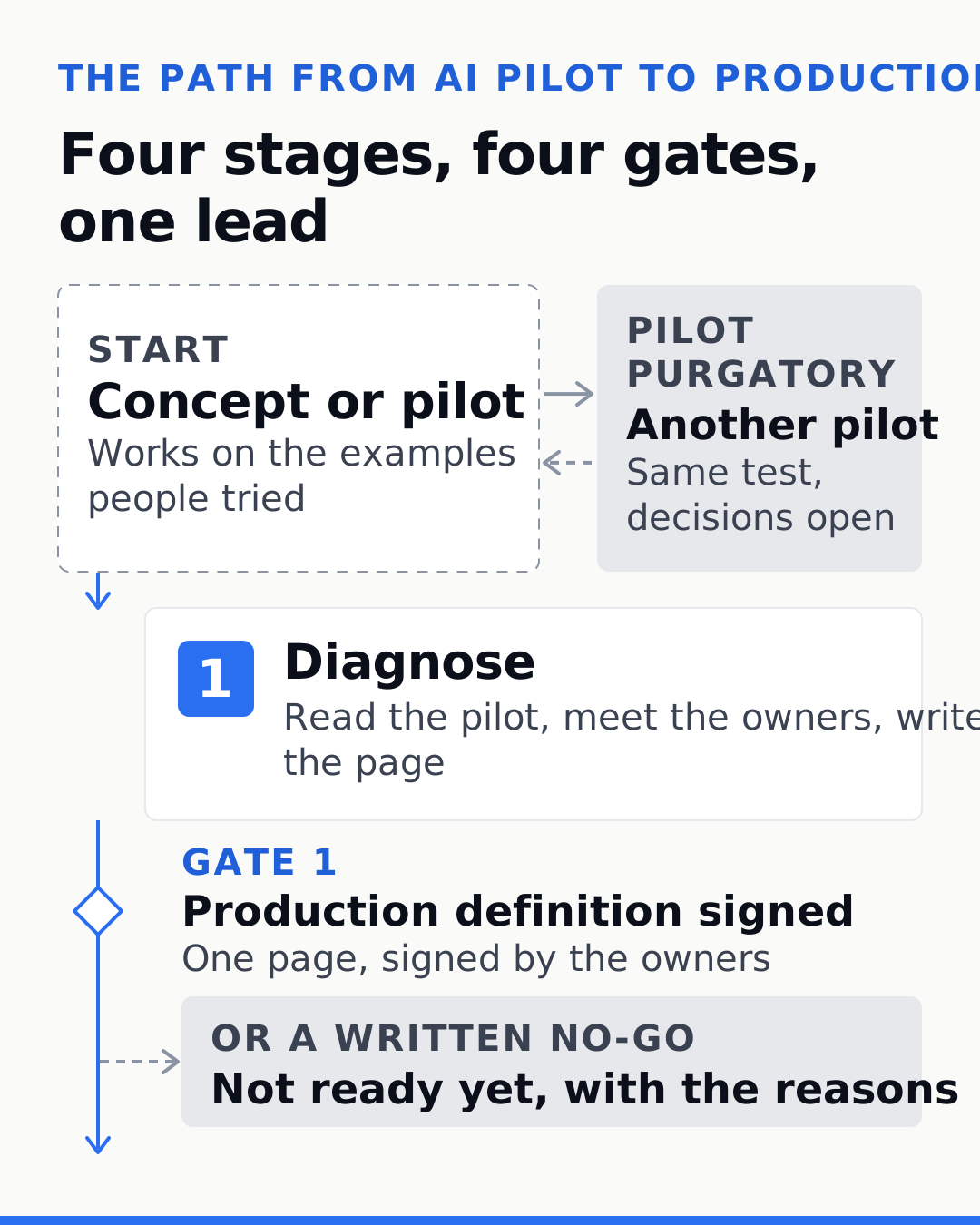
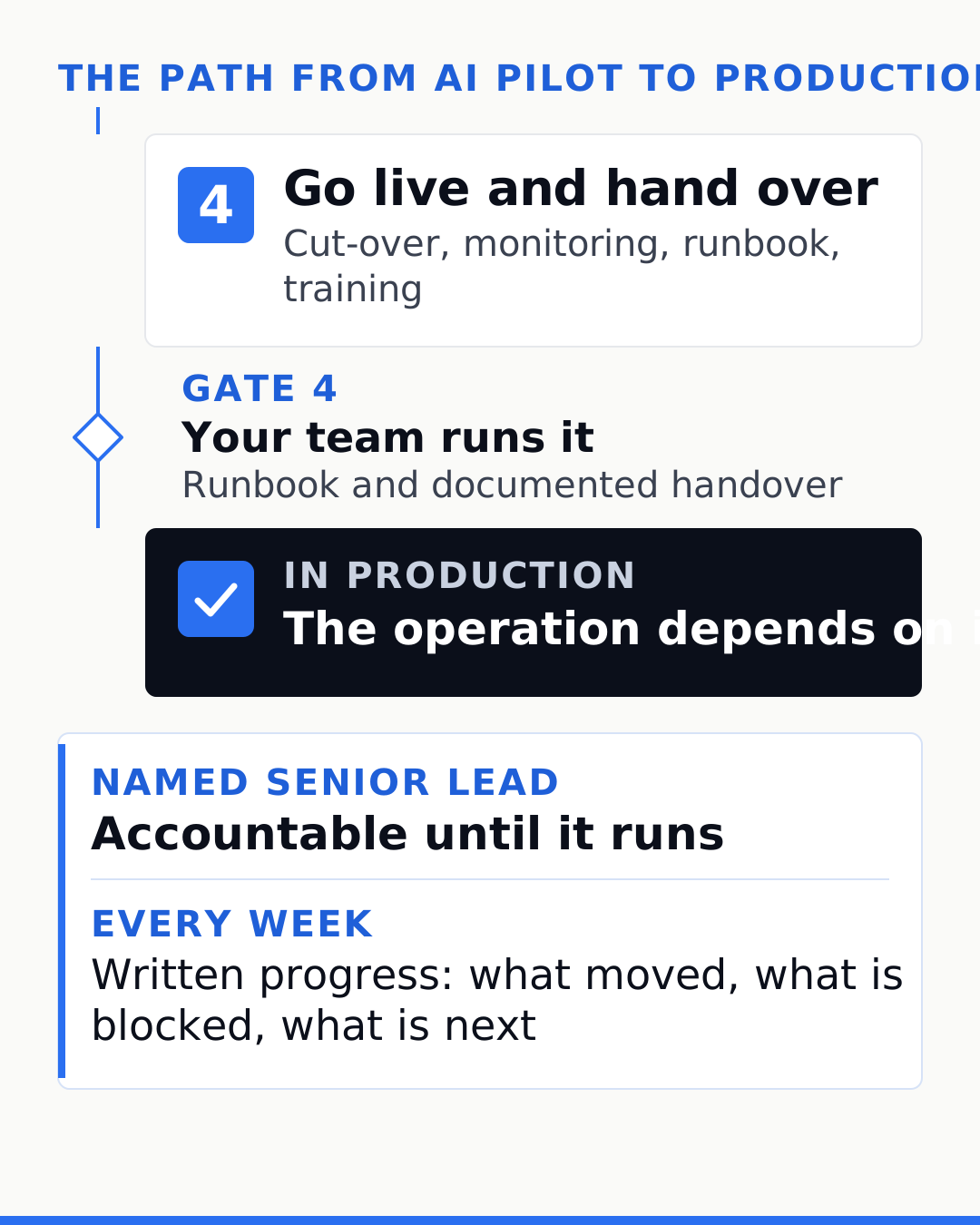
- Diagnose. Read the pilot, meet the accountable business and technical owners, learn how the operation actually runs, and write one page that defines production. Two weeks.
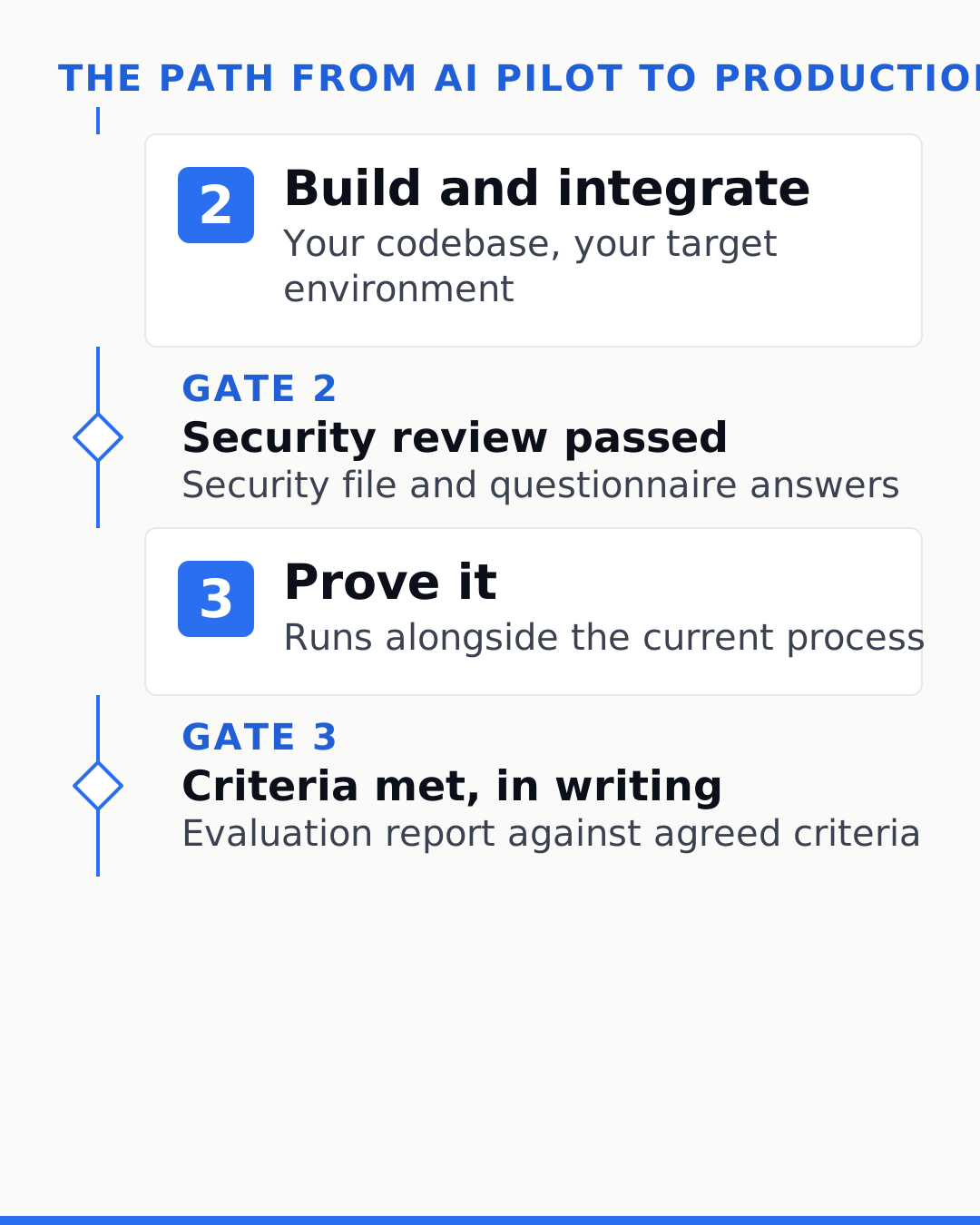
- Build and integrate. Work in your codebase and your target environment, under the identity, data and security constraints production requires.
- Prove it. Run the system alongside the current process and measure it against the criteria the owners signed.
- Go live and hand over. Cut over, monitor from the first day, train the team, deliver a runbook.
| Stage | The question it answers | Gate that closes it | What you hold at the gate |
|---|---|---|---|
| 1. Diagnose | What does production mean for this system? | Production definition signed | One signed page, or a written no-go |
| 2. Build and integrate | Can it run on our systems, under our rules? | Security review passed | Working integrations, security file and questionnaire answers |
| 3. Prove it | Does it meet the criteria on live work? | Criteria met, in writing | Evaluation report against agreed criteria |
| 4. Go live, hand over | Can our team run it without us? | Your team runs it | Runbook and documented handover |
The week-by-week version, with what happens inside each stage, is in how a forward-deployed engineering engagement works.
Why do the gates matter more than the stages?
Because stages describe work, and gates describe decisions. Most teams can describe the work. What stops a pilot is a decision nobody made: which systems it connects to, who reviews its security, what “good enough” means, which outputs a person approves, and who runs it next quarter.
When those decisions stay open, teams run another pilot. It tests again whether the AI can do the task, which the first pilot already showed, and the decisions stay open. That loop is what people call AI pilot purgatory. We covered the five open decisions behind it in why AI pilots stall, and what moves them.
A gate closes that loop. It turns each open decision into a document with a signature, so nobody has to reopen it later.
Site reliability engineering has used the same idea for years. Google’s SRE book describes a production readiness review as a prerequisite before a team accepts responsibility for running a service in production. An AI system deserves the same check, written down, before go-live.
Who owns each gate?
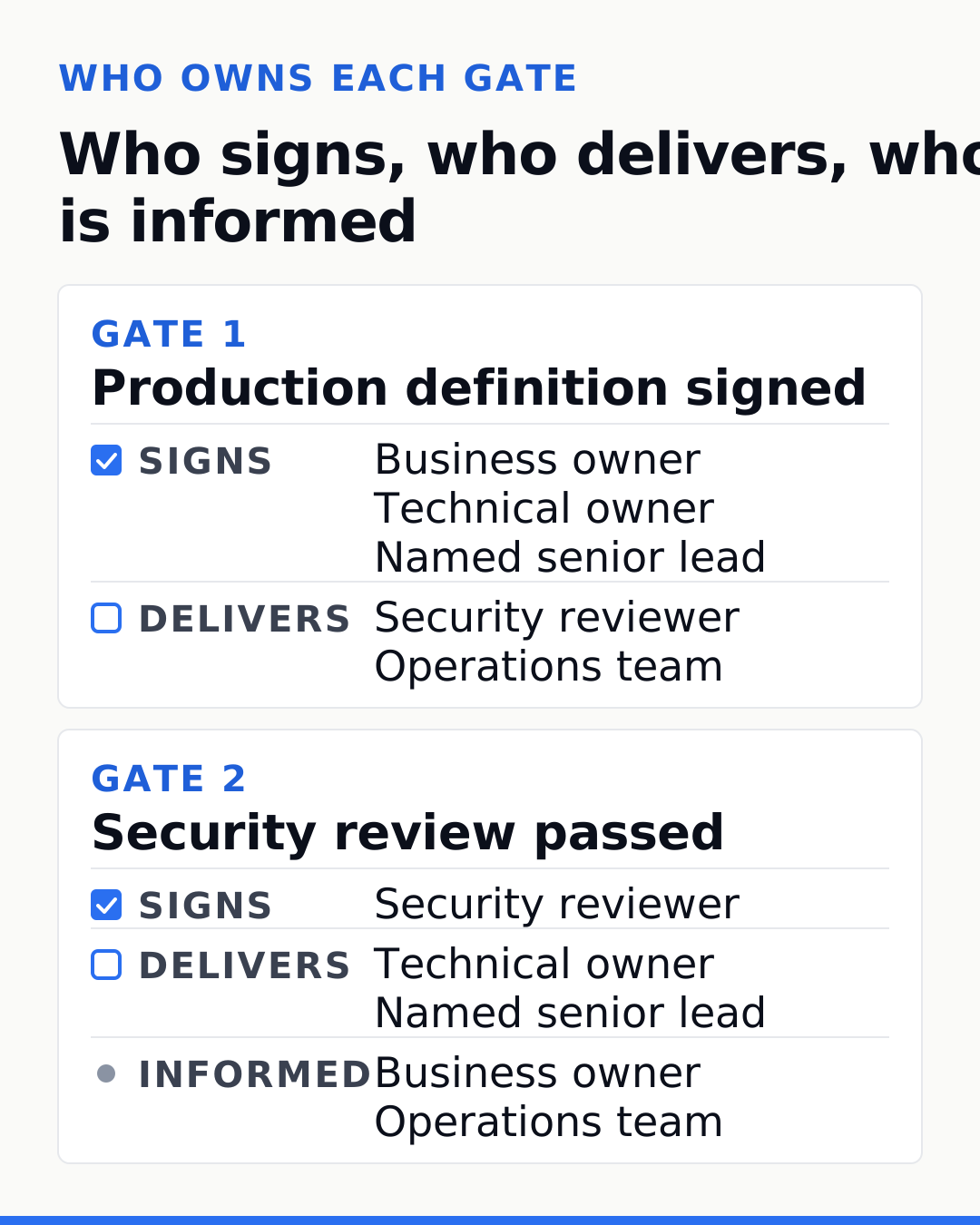
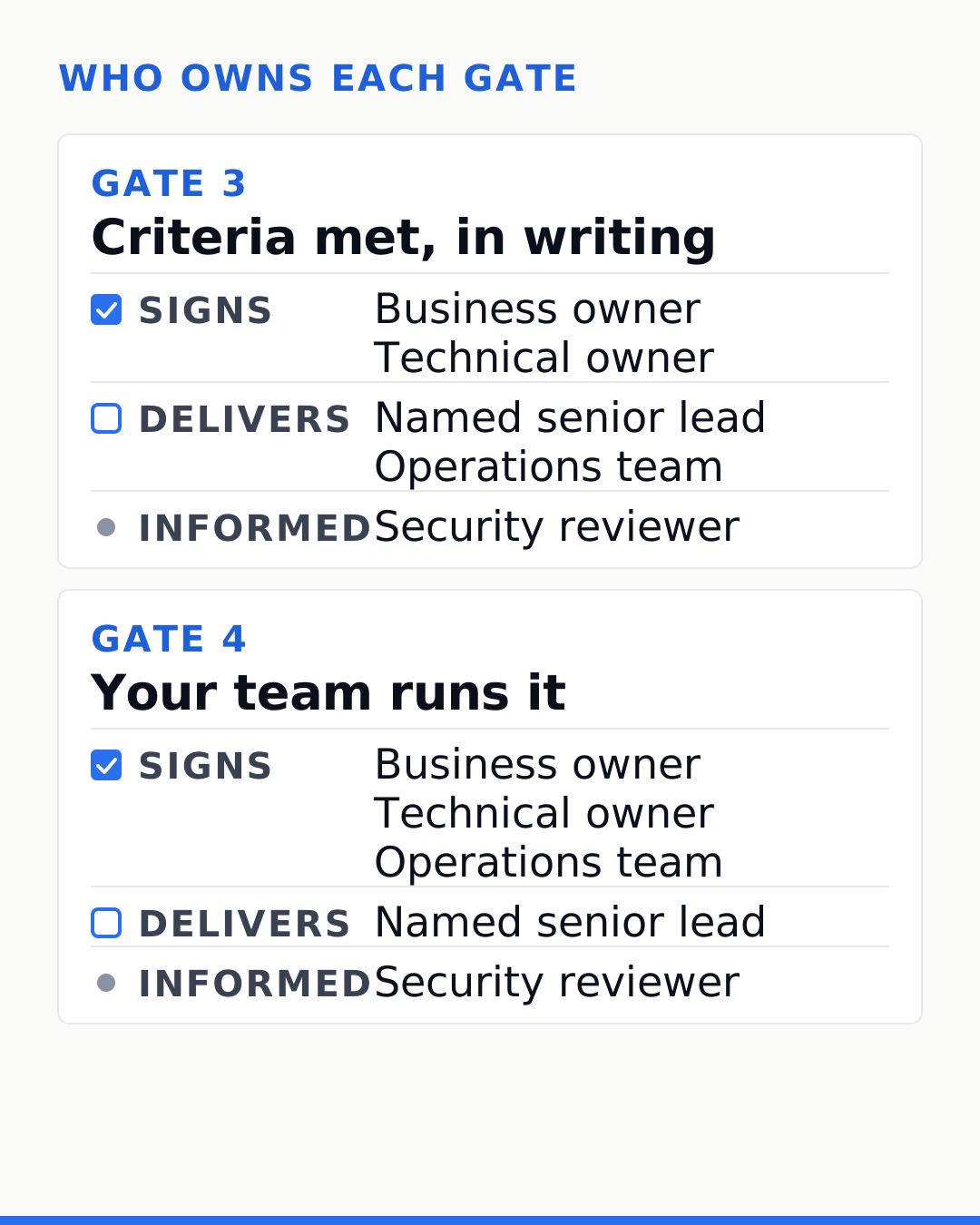
A gate with no named signer is a meeting, and meetings do not close decisions. Each signature has to come from someone who answers for what it covers.
| Role | What they answer for | Gates they sign |
|---|---|---|
| Business owner | The business result and the success criteria | 1, 3, 4 |
| Technical owner | The systems, the data access and the target environment | 1, 3, 4 |
| Security reviewer | Data flows, hosting and access, against your policies | 2 |
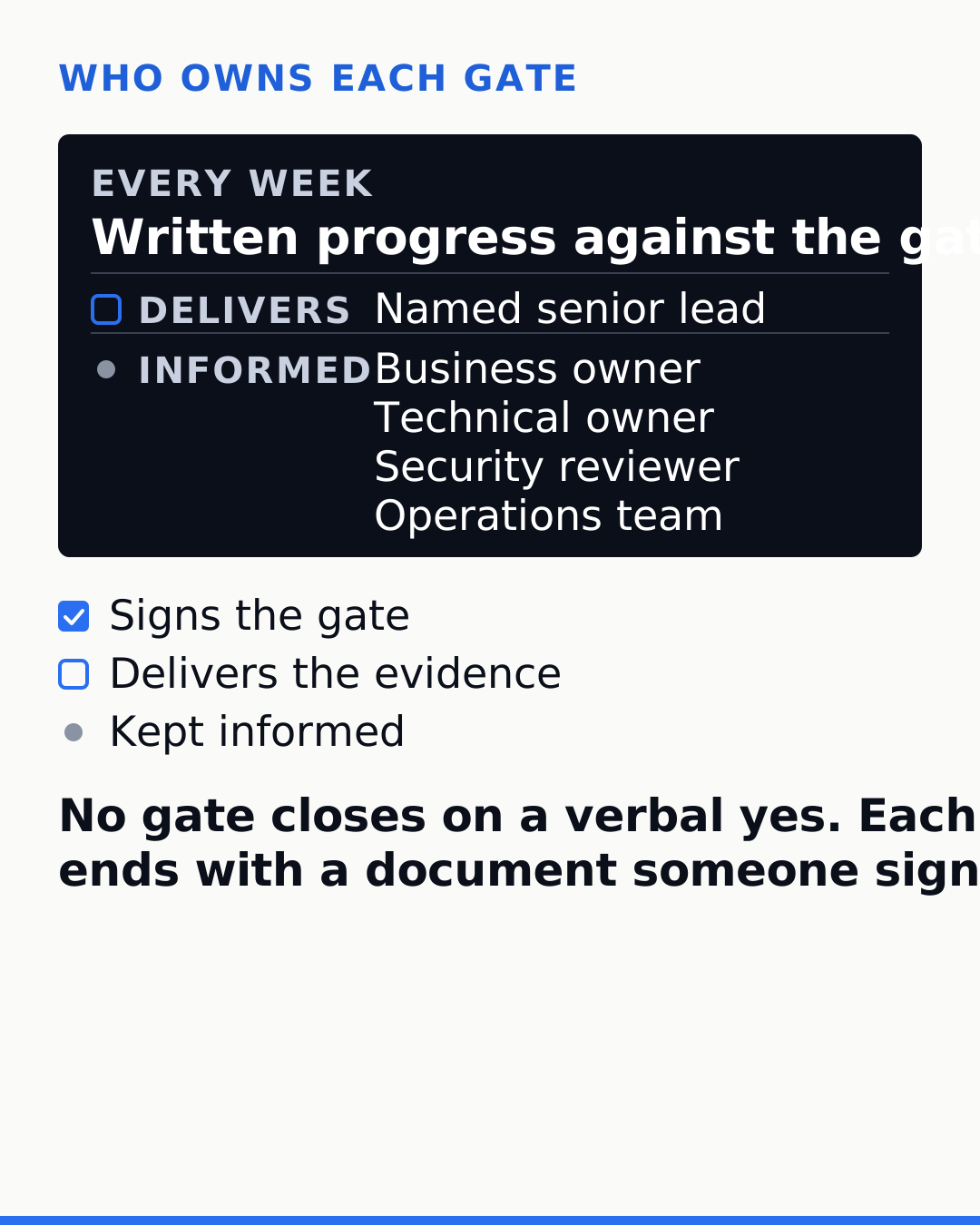
| Named senior lead | The whole path, from the first week until the system runs | 1, and every weekly report |
| Operations team | The daily use of the output, and running the system after handover | 4 |
Two owners matter most: one person who answers for the business result and one who answers for the technical system. If either seat is empty, gate 1 cannot be signed, and that is the first thing to fix.
Public frameworks ask for the same clarity. The NIST AI Risk Management Framework, a voluntary framework, asks in its core that roles, responsibilities and lines of communication for managing AI risks are documented and clear (GOVERN 2.1). The owner table above does that for one system.
The owners also decide where a person must step in before the system acts, and the build enforces it. How we approach security and governance is on our trust page.
What does AI production readiness look like at each gate?
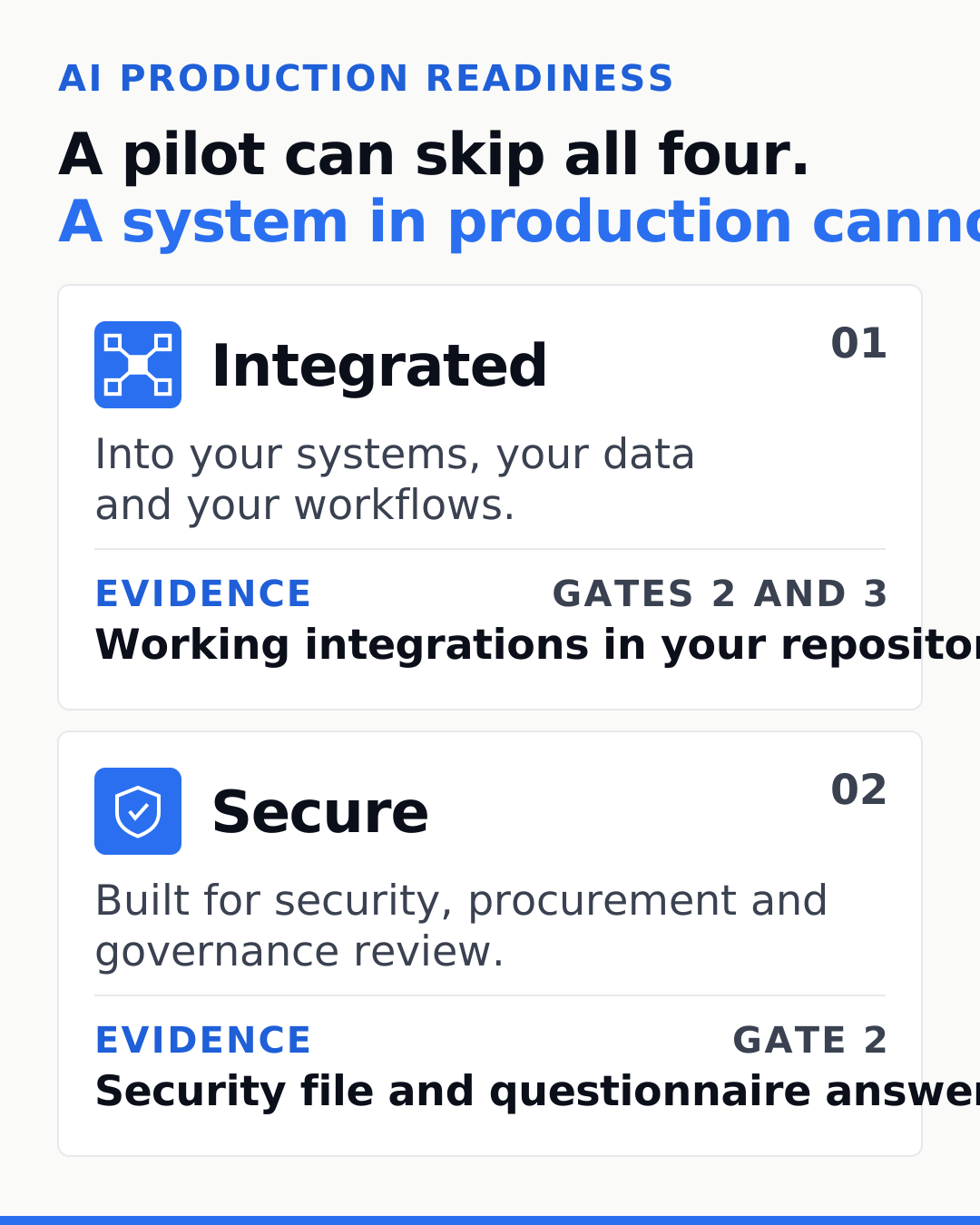
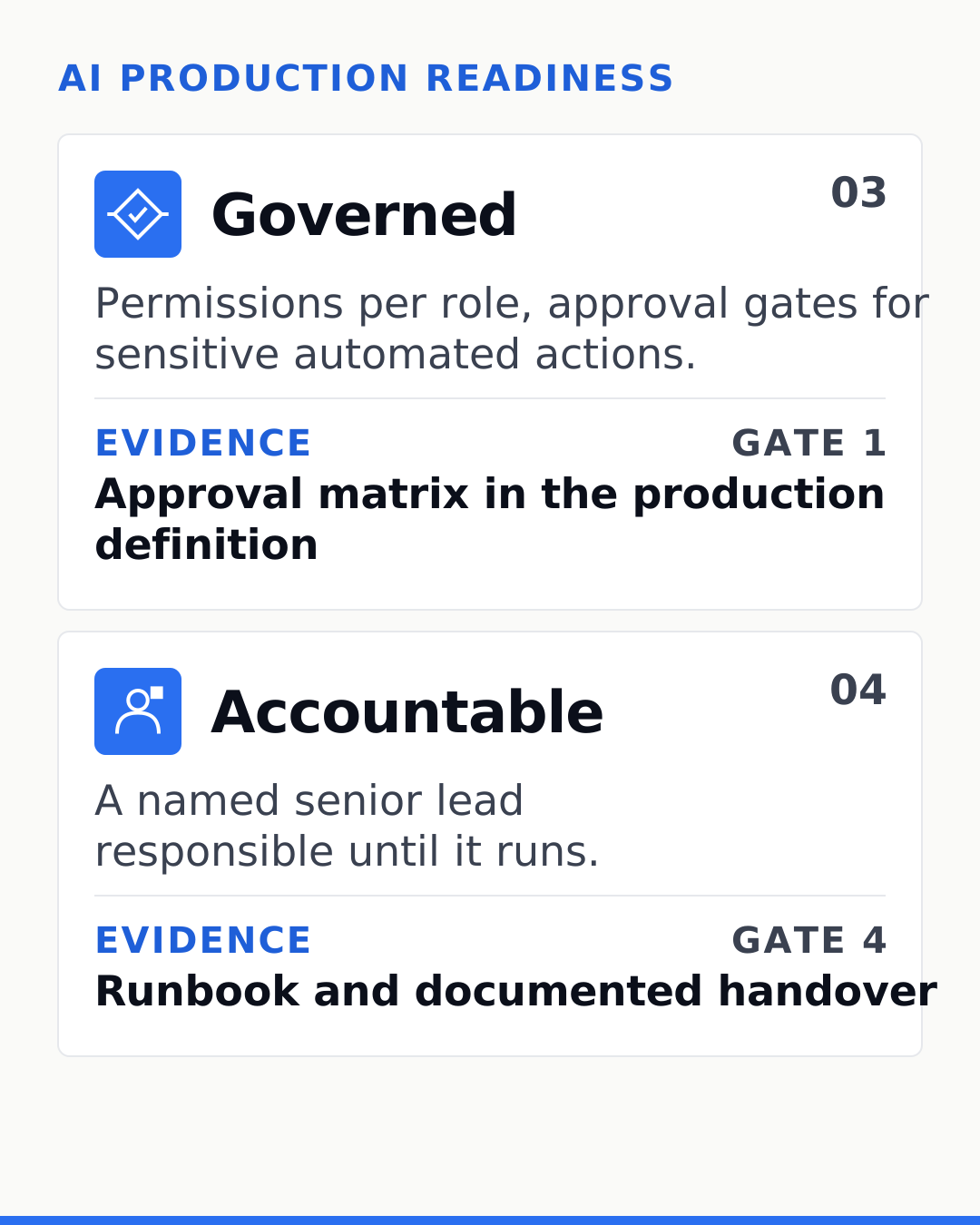
AI production readiness is the moment a system meets four conditions at once: Integrated, Secure, Governed, Accountable. A pilot can skip all four. A system in production cannot.
Each condition shows up at a gate as something you can check:
- Integrated. Into your systems, your data and your workflows. The evidence is working integrations in your repository, proven on live work at gate 3.
- Secure. Built for security, procurement and governance review. The evidence is the security file and the questionnaire answers at gate 2.
- Governed. Permissions per role, approval gates for sensitive automated actions. The evidence is the approval matrix, written into the production definition at gate 1.
- Accountable. A named senior lead responsible until it runs. The evidence is the runbook and the documented handover at gate 4.
Measurement holds the four together. Google’s ML Test Score rubric treats testing and monitoring as key considerations for the production readiness of a machine learning system. That is why the evaluation set is frozen at gate 1 and the evaluation report closes gate 3.
The page that fixes all of this before the build is the production definition. Its template and the yes or no checklist we run on each section are in the AI production readiness checklist.
How do you move an AI pilot to production when the model already works?
You stop testing the model and start closing gates. A working model is the starting point of the path, and the work that remains sits around it.
Google researchers made the point for machine learning in Hidden Technical Debt in Machine Learning Systems (NeurIPS 2015): in a real-world system, the model code is a small fraction of the whole. Data dependencies, configuration, serving infrastructure and monitoring make up the rest, and that is where production effort goes.
So the order matters. Write the production definition first, while the pilot is fresh. Then build where the system will run, so the pilot’s limited environment never becomes a surprise at go-live.
How is scaling AI from pilot to production different from running more pilots?
More pilots spread attention across systems that each stop before gate 1. Scaling means taking one system through all four gates, then reusing what it produced.
The first system leaves assets behind: a production definition format your owners know how to sign, a security file your reviewers have already read, an approval matrix, a runbook structure. The second system starts from those. The gates stay the same; fewer decisions start from zero.
That is why we recommend one system, in production, before a portfolio of pilots. A running system answers the questions a slide cannot.
When should a pilot stop instead of moving forward?
When gate 1 cannot be signed. If the success criteria cannot be agreed, the data cannot be reached or nobody will own the system afterward, the pilot is not ready for production.
The NIST framework asks for that call too: a determination of whether the AI system achieves its intended purposes and whether its development or deployment should proceed (MANAGE 1.1). A written no-go in week two, with the reasons, names what has to change before more budget is spent.
Where does forward-deployed engineering fit on this path?
Forward-deployed engineering is how OrNsoft runs this path for a client. Bring us the problem, not the specification. Our forward-deployed engineers work directly with your business and technical teams, learn how your operation actually runs, determine what has to be built, and move the system from pilot to production.
You explain the objective once. A named senior lead owns the four gates, and the owners receive written progress every week: what moved, what is blocked, which gate is next.
OrNsoft is an advanced AI engineering firm, founded in Florida in 2009, with applied AI in its software since 2015.
What should you do next?
Take your pilot and name the owner of each gate:
- Who signs the production definition for the business, and who for the technical system?
- Who reviews its security, and against which policies?
- Who decides the criteria are met, and on which evaluation set?
- Who runs it after handover, and with which runbook?
Every blank is the next decision to make. One call is enough to know whether we can help. Book a call.
Questions
- How do you move an AI pilot to production?
- Start by writing the production definition, before any new code: it forces the open decisions into the first two weeks. If the pilot team has moved on, find whoever knows its data and test results, because the diagnosis starts there.
- What are the gates between an AI pilot and production?
- Four: the signed definition, the passed security review, the criteria met on live work and the takeover by your team. A failed gate does not end the project. Treat it as a return to the stage before it, with the reason in writing. The criteria themselves can change, but only with the signatures of the owners who set them.
- Who signs off on an AI system before it goes live?
- Mainly the business and technical owners, with security signing its own review. In a smaller company one person may hold both owner roles, which works as long as that signature covers the result and the system. A committee does not work: when everyone signs, nobody owns the outcome.
- What is AI production readiness?
- A quick test is to ask for the evidence of each condition. If you cannot open the security file, the evaluation report and the runbook, the system is still a pilot, whatever the status slide says.
- How long does it take to move an AI pilot to production?
- Ask for a date only after the diagnosis, since a go-live date set before anyone has read the pilot is a guess. The slowest items often sit outside the build, access requests and the security review, so start both in the first week.
- How do you scale AI from pilot to production across several systems?
- Pick the first system for what it teaches as well as for its value: one that touches the main systems and the security review the later ones will also need. That way the reuse is real when the second system starts.
Bring us the problem.
Book a call