
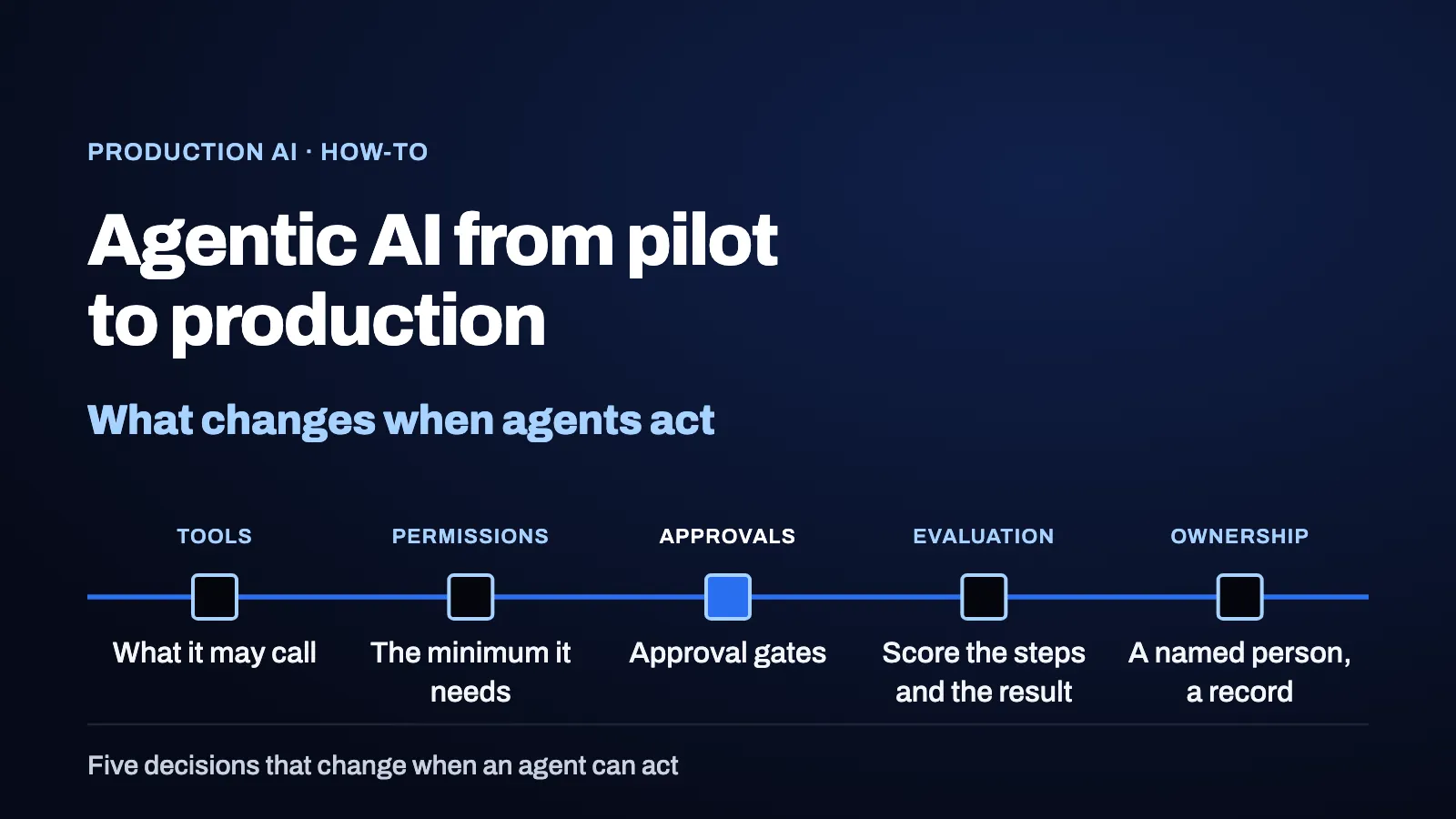
Agentic AI from pilot to production is harder than a chat assistant from pilot to production for one reason: the output is an action, not a paragraph. Once an agent can call tools and change things in other systems, five decisions matter more than they did in the pilot: which tools it may call, which permissions it holds, which actions need approval, how you evaluate it, and who answers for it.
An AI agent is a system in which a model chooses and calls tools to reach a goal, so its output is an action in your operation, not only text for a person to read.
This article is for operators and technical owners who have an agent pilot, or plan one, and need to move it into production. It takes the five decisions in turn, with an example of one agent run and where the approval gate sits. It builds on AI pilot to production.
Key takeaways
- An action is the unit of risk. Decide controls per action, not per system.
- Give the agent the minimum. Fewer tools and fewer permissions limit what a wrong step can do.
- Gate by consequence. Irreversible or external actions wait for a named approver.
- Evaluate the steps. Score the tool calls and the result, not only the final text.
- Name an owner. One business owner answers for what the agent does.
What changes when agentic AI goes from pilot to production?
A chat assistant produces text, and a person decides what to do with it. An agent decides, calls a tool, and the action happens. The review step that was built into the pilot, a person reading the answer, is no longer in the path unless you put it back.
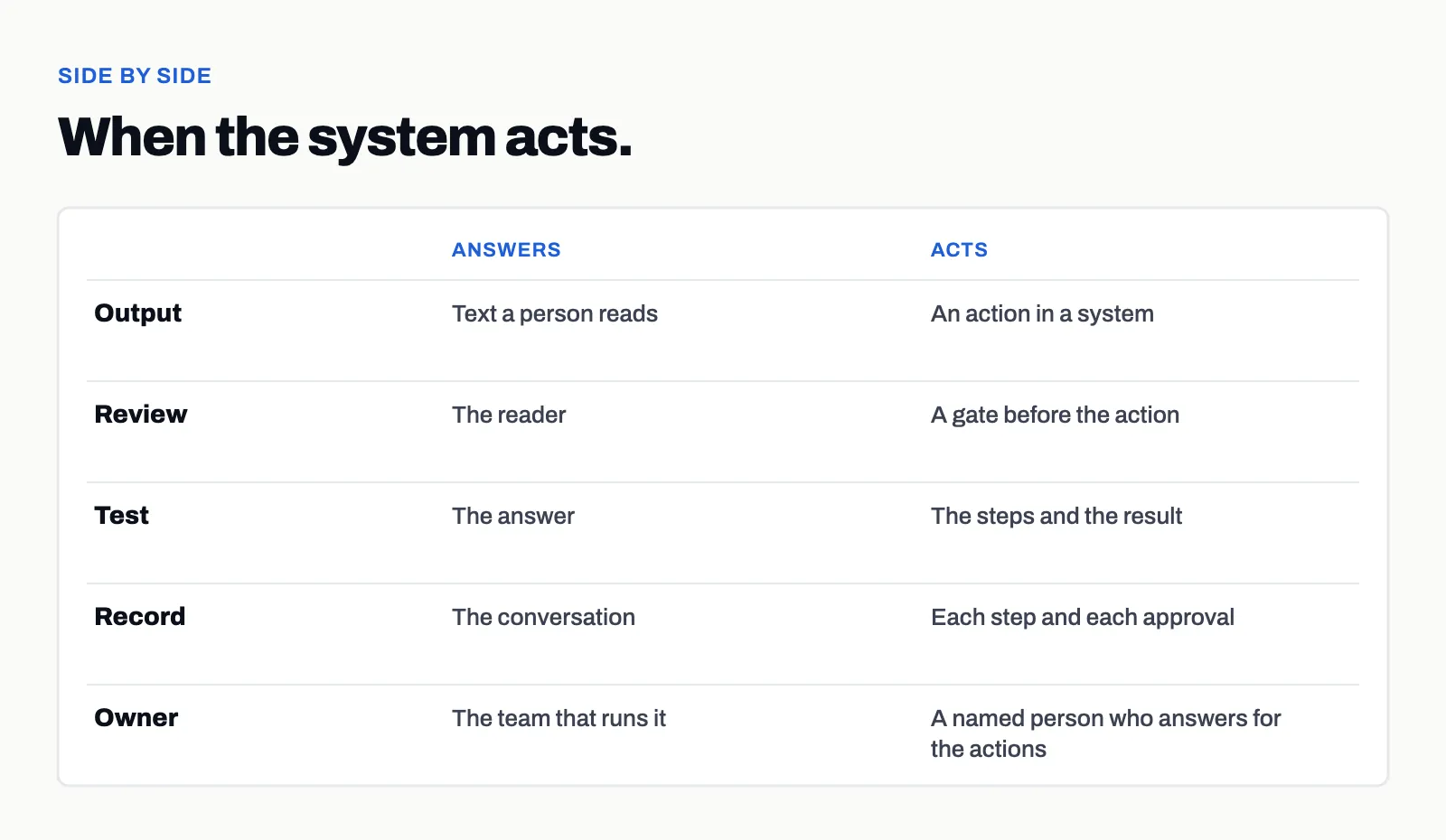
That is why the pilot’s results do not carry over automatically. A pilot shows that the model can choose the right step on examples. Production asks what happens on the examples nobody chose, and who is answerable when the action is wrong.
Which tools should the agent be able to call?
Start with the smallest set that does the job. Each tool is a door into another system, and every extra door is something to secure, test and explain.
OWASP’s entry on excessive agency describes the vulnerability as damaging actions performed in response to unexpected, ambiguous or manipulated output from an LLM, and lists its typical root causes as excessive functionality, excessive permissions and excessive autonomy. The first two are decisions you make at design time: offer only the tools the task needs, and narrow what each tool can do.
Which permissions should it hold?
Give each tool the minimum permission it needs, under a named service role, owned by a named person. A tool that only needs to read a record should not be able to change it. The connection work for each system is covered in integrating an AI pilot with the systems you already run.
Which actions need an approval gate?
Sort the actions an agent can take by consequence.
- Reads need no gate.
- Reversible writes, such as drafting a reply or creating a task, need none or a sampled review after the fact.
- Irreversible or external actions, such as paying, deleting, changing an access right or writing to a client, wait for a named approver with a backup.
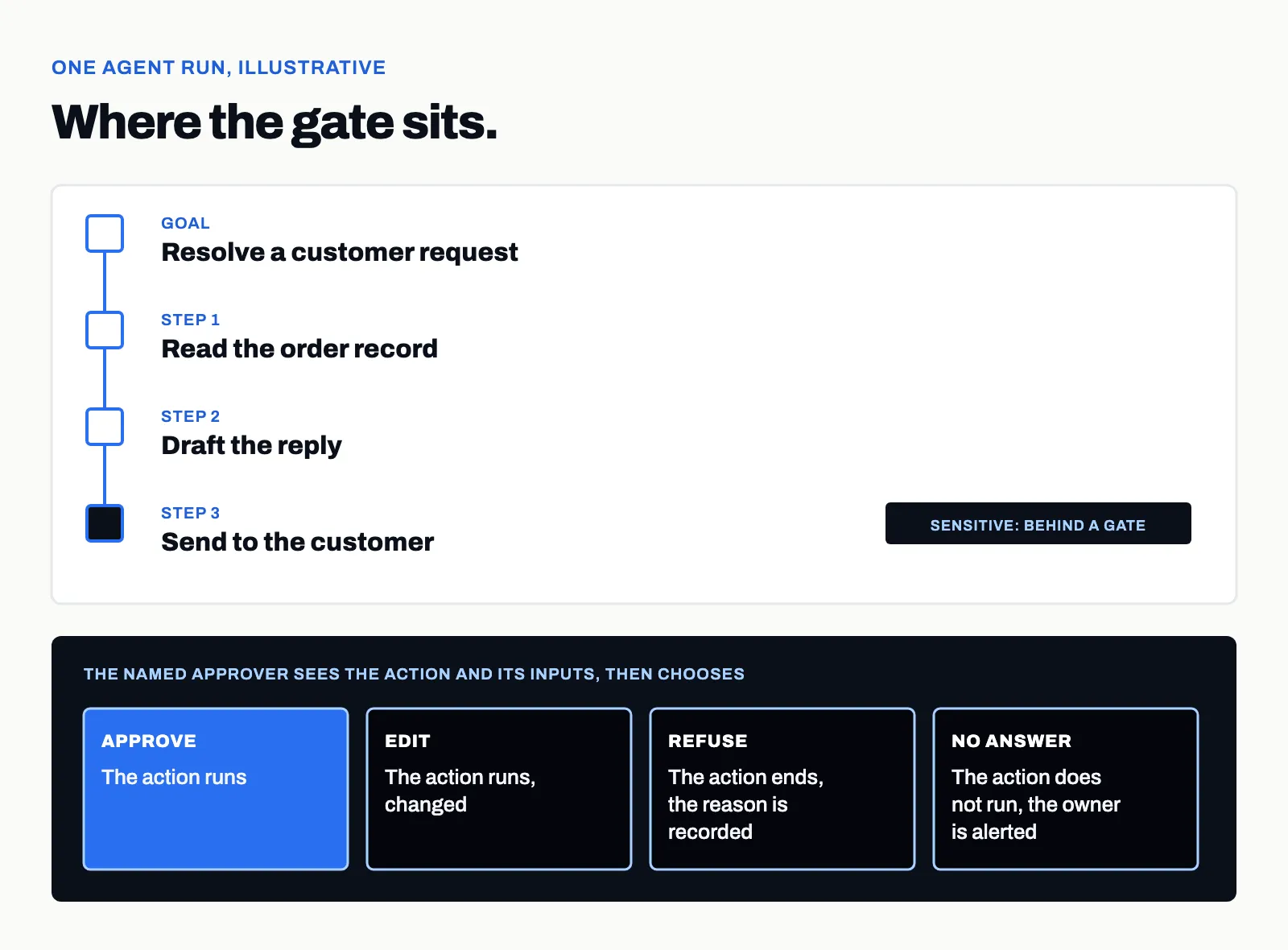
The gate only works if the approver sees the action as it would run and the inputs behind it, and if the timeout is decided in advance: no answer means the action does not run and the owner is alerted. The design choices are in approval gates for sensitive automated actions.
How do you evaluate an agent?
Evaluate the path, not only the destination. A final answer can look right while a tool call along the way was wrong, and a wrong call that happened to be harmless today can be harmful tomorrow. Score the tool choices, the inputs passed to each tool, and the final result, on cases from your own operation.
Do it before go-live to decide whether to ship, and after go-live on a sample of real runs, as set out in how to evaluate AI agents. The scoring itself is explained in what LLM evals are.
Who answers for the agent?
A named business owner answers for what the agent does. A named technical owner runs it. Each has a backup. Their names, the actions that need approval, and what happens on refusal or timeout all belong on the page that defines production, signed before go-live, as described in define production for an AI system.
Record each run in a way that lets someone else reconstruct it later: the input, the steps, the tool calls, the approval and the result. When a pilot stalls because nobody can say who is accountable, this is one of the open decisions described in why AI pilots stall.
What goes wrong without these decisions?
Three patterns repeat.
- The agent has more access than its job needs. A wrong step can then reach further than anyone planned.
- The gate exists but has no timeout rule. The first unanswered approval stops the process, or someone bypasses it.
- Only the final text was tested. The first wrong tool call shows up in production.
What should you do next?
Take one agent pilot and list every action it can take. Sort each into the three tiers, name an approver for every sensitive one, and write the timeout rule beside it. If a row is blank, you have found your next decision. The wider path is in how to move an AI pilot to production.
Designing the approval path and taking the system to production is part of our forward-deployed engineering work, described on the forward-deployed engineering page.
Bring us the problem, not the specification. Book a call. One call is enough to know whether we can help.
Before agents act, score your pilot against 20 questions.
Questions
- What is agentic AI?
- A system in which a model chooses and calls tools to reach a goal, so it takes actions in other systems and does not only produce text for a person to read.
- What changes when an AI agent can act?
- The output is an action, so five decisions matter more: which tools it may call, which permissions it holds, which actions need approval, how you evaluate steps and results, and who answers for it.
- How do I decide which agent actions need approval?
- Sort actions by consequence. Reads need no gate. Reversible writes need none, or a sampled review. Irreversible or external actions, such as paying or writing to a client, wait for a named approver.
- How do you evaluate an agent?
- Score the steps and the final result on cases from your own operation, before and after go-live. A correct final answer can hide a wrong tool call along the way.
- What is excessive agency?
- An OWASP term for an LLM system that can take damaging actions in response to unexpected, ambiguous or manipulated output. Its listed root causes are excessive functionality, permissions or autonomy.
- Who should own an AI agent in production?
- A named business owner who answers for its actions, and a named technical owner who runs it. Write both names, and a backup for each, into the page that defines production.
Bring us the problem.
Book a call