
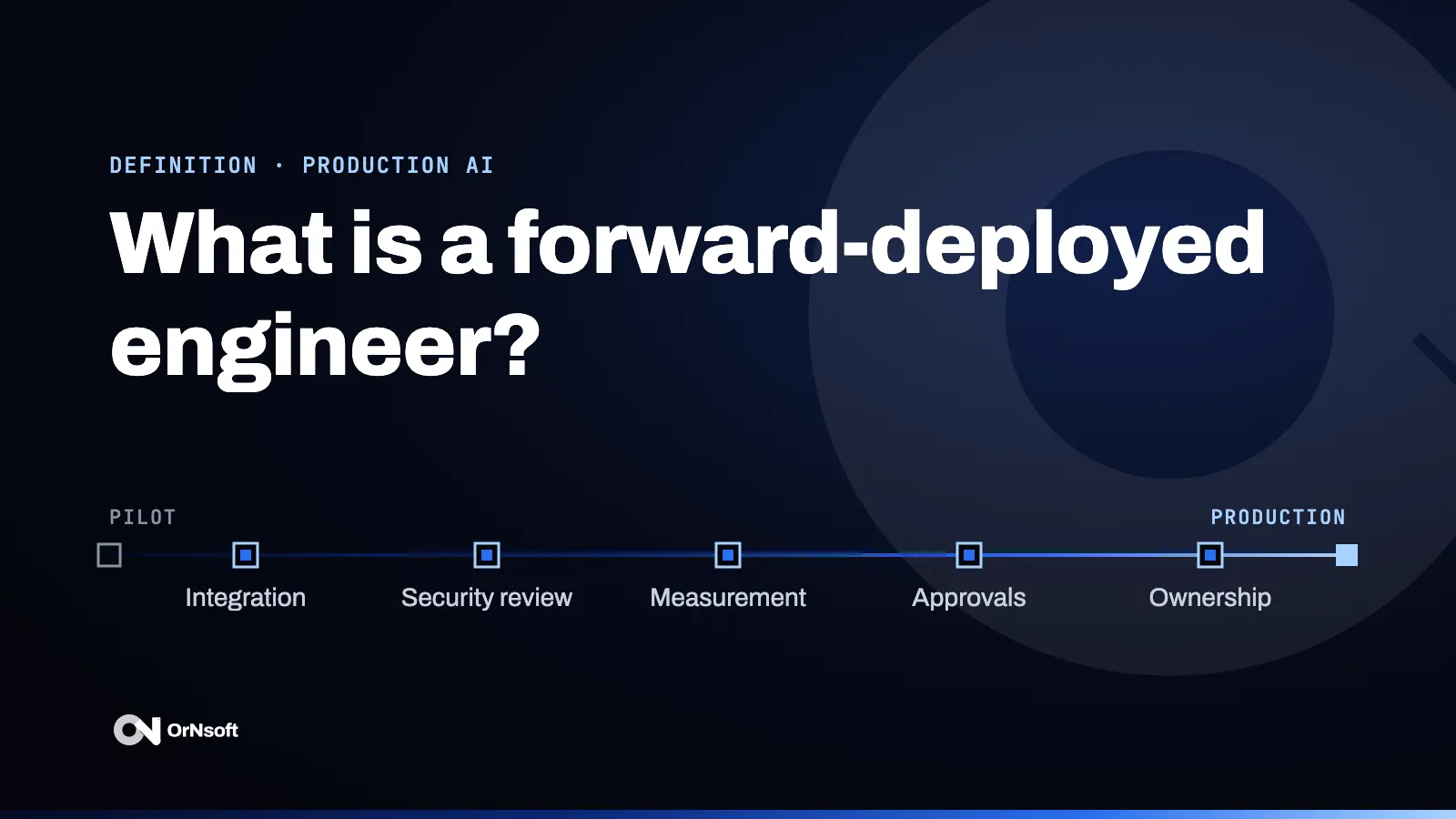
What is a forward-deployed engineer? A senior engineer who works directly with a company’s business and technical teams to get an AI system working in production. The role exists because, in our experience, AI pilots rarely stall on the model. They stall on everything around it: integration, security review, measurement, approvals and ownership.
A forward-deployed engineer is a senior engineer who works directly with a company’s business and technical teams, learns how the operation actually runs, determines what has to be built and takes ownership of moving an AI system from pilot to production.
Key takeaways
- A forward-deployed engineer owns one outcome: an AI system running in production in your operation.
- You receive concrete deliverables at each stage.
What is a forward-deployed engineer, seen from the buyer’s side?
The practice forward-deployed engineers belong to is called forward-deployed engineering. This article explains the role from the buyer’s side: what a forward-deployed engineer owns, what you should receive, and when the role is the right answer.
Analysts see the same constraint. Forrester argues that the constraint on enterprise AI is no longer only model performance, but organizational readiness.
What does a forward-deployed engineer do?
A forward-deployed engineer turns a working pilot into a system the operation can rely on every day. The work happens where the system will run: in your codebase, in your target environment, under your identity, data and security rules.
In practice, the role covers five jobs:
- Integration. Connect the AI to the systems it depends on, under the required identity and permissions.
- Security review. Document data flows, hosting and access, and answer the review so go-live can happen.
- Measurement. Build an evaluation set with the accountable owners, and measure before and after go-live.
- Approvals. Define which outputs a person must approve, then add approval gates and an audit log.
- Ownership. Stay accountable through deployment and adoption, then hand over with a runbook.
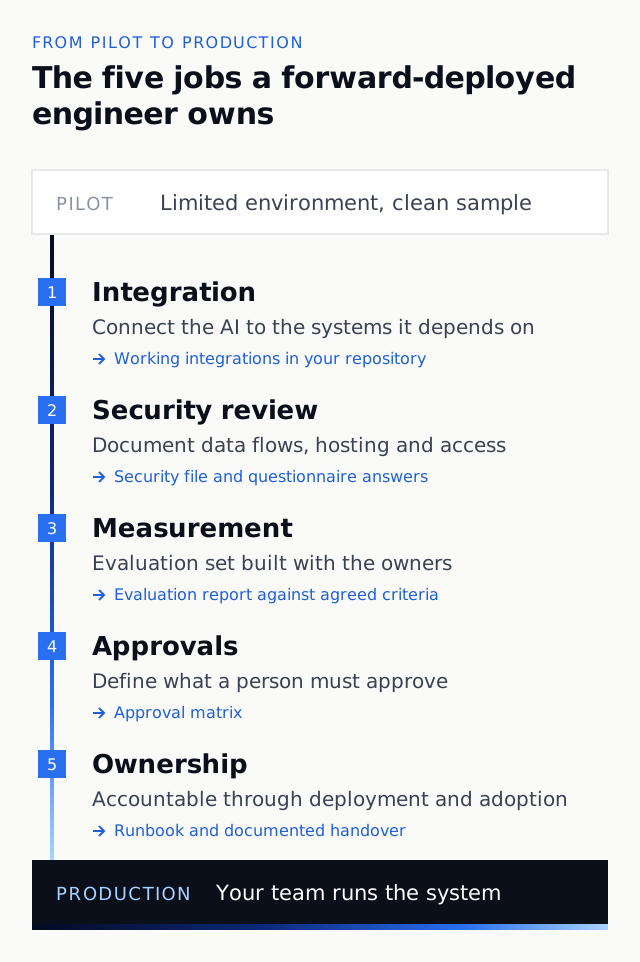
Each of these is a reason pilots stall. The forward-deployed engineer takes ownership of all five, so nobody has to coordinate them across separate teams.
Public frameworks for trustworthy AI cover the same ground. The NIST AI Risk Management Framework organizes the work into four functions: Govern, Map, Measure and Manage. The OECD AI Principles make accountability one of their values-based principles. ISO/IEC 42001 sets requirements for an AI management system.
Why is the role called “forward-deployed”?
The name describes where the engineer works: forward, with the people who run the operation, instead of behind a ticket queue at a vendor. The engineer learns the business problem first, from the people who live with it, and decides what to build from there.
That changes the starting point of a project. Instead of a long specification written before anyone has seen the operation, the client explains the objective. At OrNsoft we put it this way: Bring us the problem, not the specification. You explain the objective once.
What does a forward-deployed engineer deliver?
A buyer should be able to name what they receive at each stage. In a forward-deployed engagement, the deliverables are concrete:
| Stage | What you receive |
|---|---|
| Integration | Working integrations in your repository |
| Security review | Security file and questionnaire answers |
| Measurement | Evaluation report against agreed criteria |
| Approvals | Approval matrix |
| Handover | Runbook and documented handover |
The test is simple. At the end, the system runs in production and your team runs it.
How is a forward-deployed engineer different from other engineering roles?
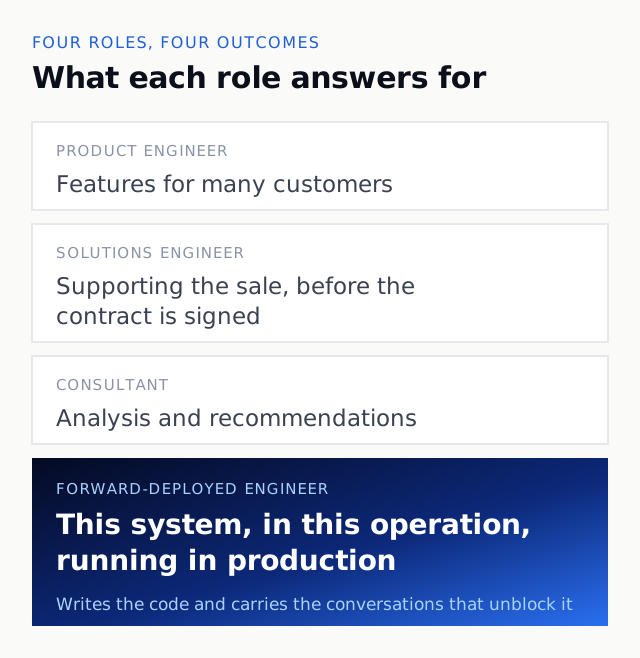
The difference is the outcome they answer for.
- A product engineer at a software company builds features for many customers.
- A solutions engineer supports the sale: they demonstrate the product and scope the fit before a contract is signed.
- A consultant delivers analysis and recommendations.
A forward-deployed engineer answers for one thing: this system, in this operation, running in production. They write code, but they also carry the conversations that unblock production, with security, with the business owner and with the people who will use the system.
For the full comparison with one of these roles, read forward-deployed engineer vs solutions engineer: what each one owns.
When do you need a forward-deployed engineer?
Two situations come up again and again.
Your AI pilot works, but it has stalled. The pilot ran on a limited environment and a clean sample of data. Production means live systems, identity, permissions and a security review. Nobody owns that gap, so the project waits.
You are an AI company that has sold an enterprise customer. The contract is signed. Now the system has to run in the customer’s environment, connect to their systems and pass their security review. Your product team cannot pause the roadmap to do it.
In both cases the need is the same: someone senior who owns the path from pilot to production and stays until the system runs.
How does OrNsoft work as a forward-deployed engineering team?
OrNsoft is an advanced AI engineering firm, founded in Florida in 2009, with applied AI in its software since 2015. We build our own AI products and bring client AI systems from concept or pilot to production. Forward-deployed engineering is one of our two offers, next to Platform builds.
Our engagements follow the same rules every time:
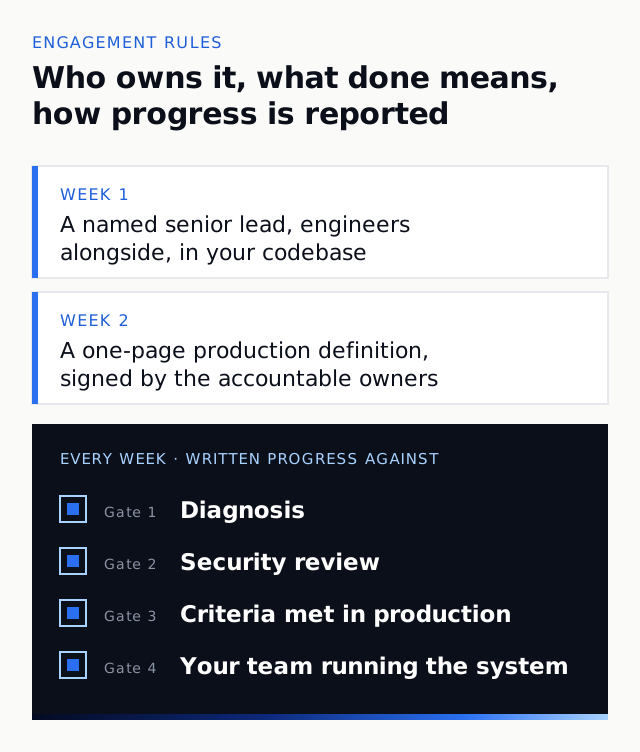
- A named senior lead from the first week, with engineers alongside, working in the relevant codebase and target production environment.
- A production definition signed by the accountable business and technical owners in week two: one page that says what “done” means. If we cannot write this page with you, we tell you the pilot is not ready for production. Here is how to define production for an AI system on one page.
- Weekly written progress against these gates: diagnosis, security review, criteria met in production, and your team running the system.
- Remote by default, in your tools, and on site for kickoff, go-live or whenever the project requires it.
The phases behind these gates are described in how a forward-deployed engagement works, week by week.
The approach comes from seventeen years in production since 2009: 1,000+ projects delivered, 98% on-time delivery, and some of the systems we built have run in production for more than a decade.
What should you ask before you bring in forward-deployed engineers?
Four questions separate a forward-deployed team from a team that only writes code:
- Who is accountable, by name, until the system runs? You want one senior lead.
- What does “done” mean, in writing? Ask to see the production definition before the build starts.
- How is progress reported? Weekly, in writing, against gates you agreed.
- What do you own at the end? At OrNsoft the answer is written into the engagement: “The project-specific code, integrations, evaluation assets and documentation we produce are yours.”
If the answers are vague, the role is a label. If they are precise, you are talking to a forward-deployed team.
What happens next?
If you have a pilot that has to reach production, or an enterprise customer waiting for a system to go live, see how forward-deployed engineering at OrNsoft runs, or book a call. One call is enough to know whether we can help.
Questions
- What does FDE mean?
- FDE stands for forward-deployed engineer. It names a senior engineer who works alongside the people running your operation and stays accountable until the AI system is live in production.
- Is a forward-deployed engineer the same as a consultant?
- No. A consultant usually delivers recommendations. A forward-deployed engineer delivers a working system in production.
- What is the difference between a forward-deployed engineer and a software engineer?
- A software engineer on a product team ships features used by many customers. A forward-deployed engineer is accountable for a single system in a single operation until it runs in production.
- When does a company need forward-deployed engineers?
- When an AI pilot works but has stalled before production, or when an AI company has sold an enterprise customer and now has to deliver the system in that customer's environment.
- Who owns the work at the end of the engagement?
- The client. At OrNsoft, the project-specific code, integrations, evaluation assets and documentation we produce are yours. We close the engagement with a runbook, training and a documented handover.
Bring us the problem.
Book a call