
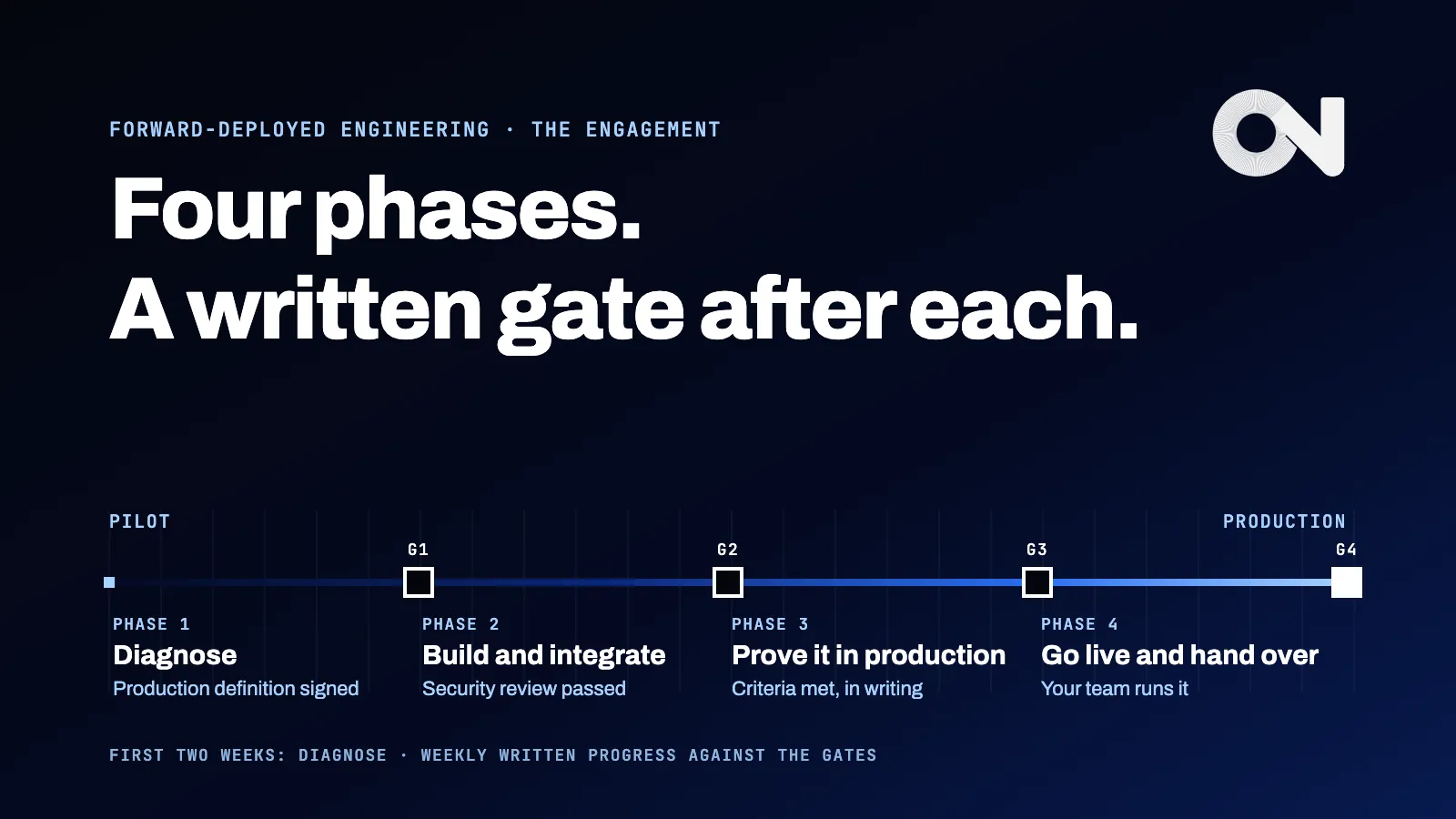
A forward-deployed engineering engagement moves an AI system from pilot to production in four phases: diagnose, build and integrate, prove it in production, then go live and hand over. Each phase closes with a written gate that the accountable owners can check. Progress is reported in writing every week, so nobody has to guess where the project stands.
A forward-deployed engagement is a delivery model in which senior engineers work directly with a company’s business and technical teams and take ownership of an AI system until it runs in production.
This article walks through how a forward-deployed engineering engagement runs at OrNsoft, what happens in each phase, and what you hold in your hands at each gate. If the role itself is new to you, start with what a forward-deployed engineer does.
Key takeaways
- Four phases, four written gates.
- Weeks one and two decide. The diagnosis ends with a signed one-page production definition, or a written answer that the pilot is not ready.
- Built where it will run.
- Proven before cut-over.
- Reported every week, in writing.
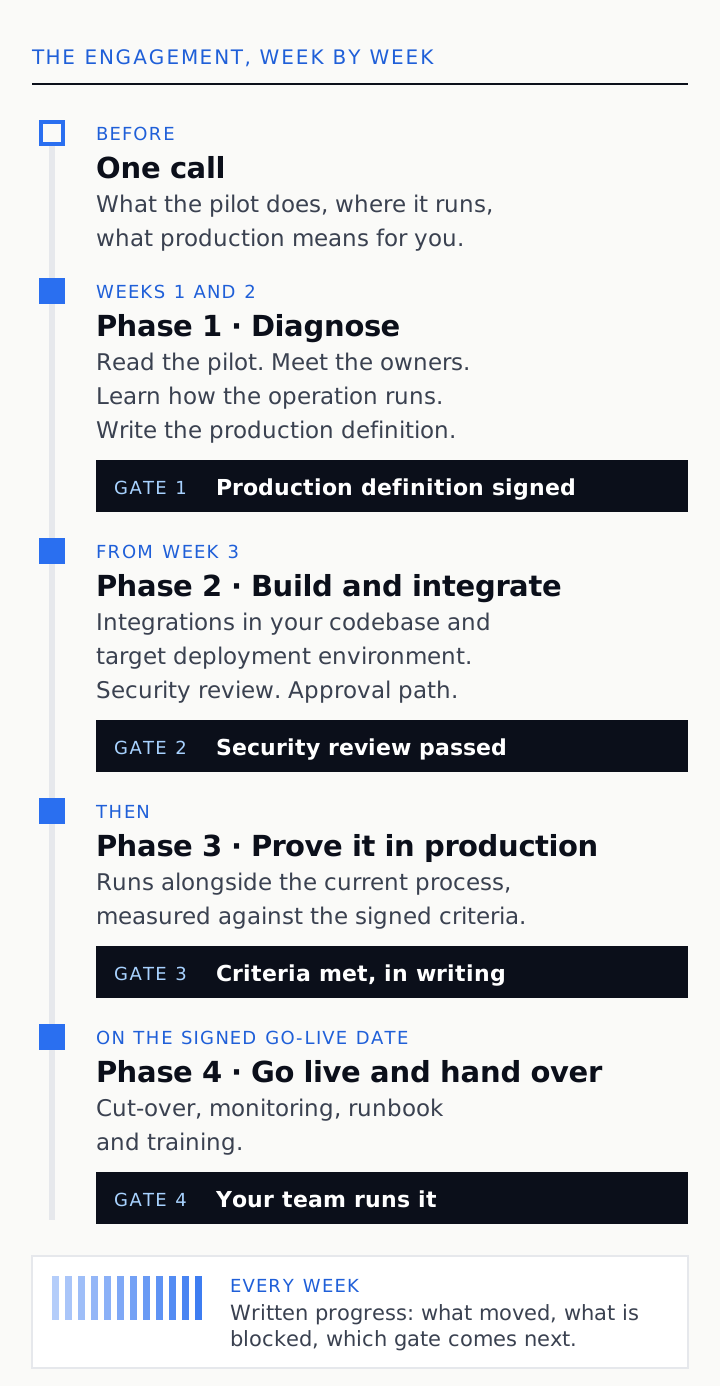
What are the phases of a forward-deployed engineering engagement?
Four phases, each with one written gate.
| Phase | When | What happens | Gate |
|---|---|---|---|
| 1. Diagnose | Weeks one and two | Read the pilot, meet the owners, write the production definition | Production definition signed |
| 2. Build and integrate | From week three | Integrations, security review, approval path, in your codebase and target environment | Security review passed |
| 3. Prove it in production | After the build | Runs alongside the current process, measured against the criteria | Criteria met, in writing |
| 4. Go live and hand over | On the signed go-live date | Cut-over, monitoring, runbook and training | Your team runs it |
What happens before the engagement starts?
One call. You tell us what the pilot does today, where it needs to run, and what production means for the business. One call is enough to know whether we can help.
Bring us the problem, not the specification. You explain the objective once, and the engagement turns it into a written plan with a named lead accountable for it.
Weeks one and two: how does the diagnosis work?
The engagement starts with a named senior lead from the first week, with engineers alongside. In the first two weeks, the team:
- Reads the pilot. Code, data, environment, the way it was tested, and what it depends on.
- Meets the accountable business and technical owners. One person answers for the business result, one for the technical system.
- Learns how the operation actually runs. Who uses the output, what they do with it, and where an error would cost something.
- Writes the production definition. One page that says what production means.
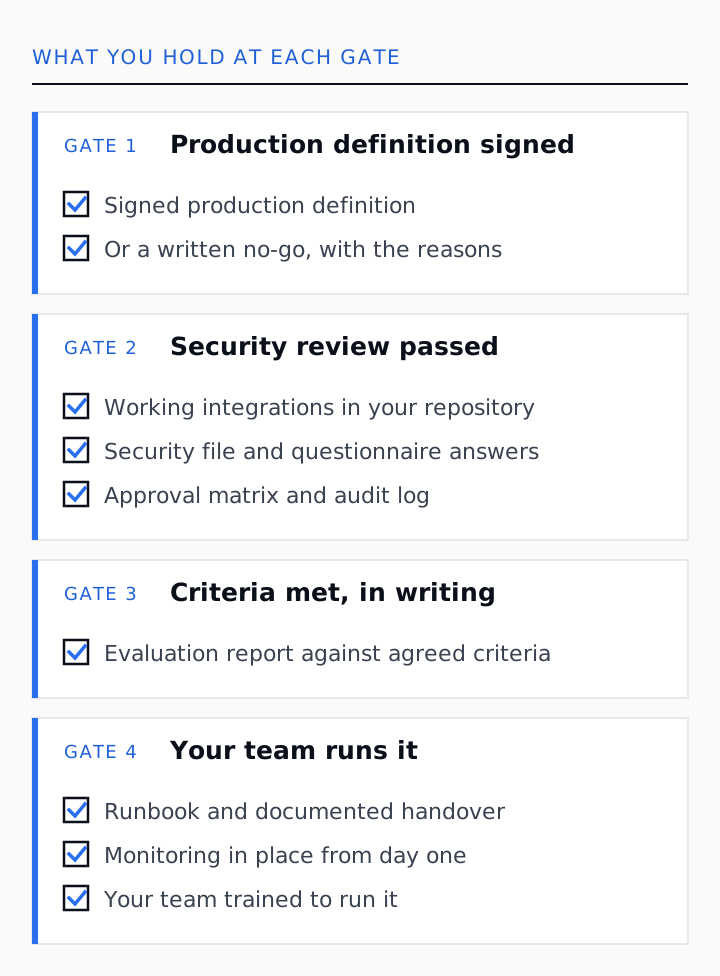
Gate 1: the owners sign the production definition, or we tell you in writing why the pilot should not go to production yet.
That second outcome matters. An honest answer in week two costs far less than a stalled build in month four.
What is in the production definition?
The production definition is the contract between the business and the system. It fits on one page and is signed by the business owner, the technical owner and the OrNsoft engagement lead.
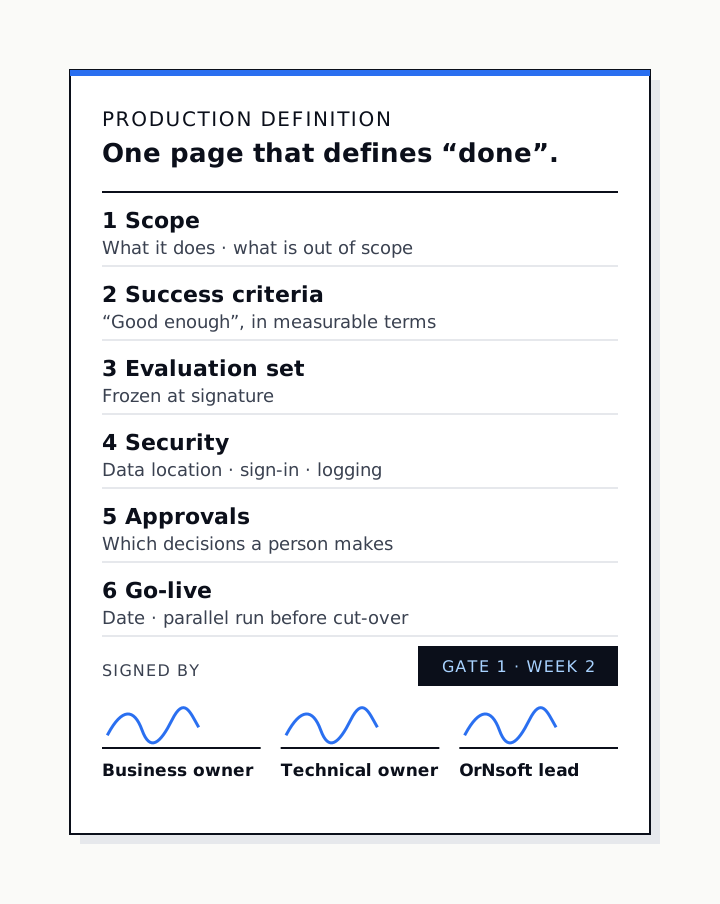
It covers six things:
| Section | What it fixes |
|---|---|
| Scope | What the system does, and what is out of scope |
| Success criteria | What “good enough” means, in measurable terms |
| Evaluation set | The examples the system is measured against, frozen at signature |
| Security | Where data stays, how people sign in, what is logged |
| Approvals | Which decisions a person makes |
| Go-live | The date, and how long the system runs alongside the current process before cut-over |
From that point, an error is a measurement against agreed criteria, not a new debate. Naming accountable owners is also what management system standards expect: ISO/IEC 42001, the international standard for AI management systems, asks organizations to assign roles, responsibilities and authorities.
The full template and checklist are in our guide on how to define production for an AI system, and the template is also shown on the forward-deployed engineering page.
How does the build and integration phase work?
The team builds in your codebase and target deployment environment, under the identity, data, integration and security constraints required for production. Working there from the start removes the classic surprise of a pilot that worked on a laptop and fails on live systems.
That surprise is well documented. In Hidden Technical Debt in Machine Learning Systems (NeurIPS 2015), Google engineers described how the ongoing costs of real-world machine learning systems come from the system around the model: data dependencies, configuration issues, changes in the external world and system-level anti-patterns.
The work in this phase:
| Workstream | What the team does | What you receive |
|---|---|---|
| Integration | Connect the AI to the systems it needs, under the required identity and permissions | Working integrations in your repository |
| Security review | Prepare and answer the review | The security file and questionnaire answers |
| Approval path | Define what a person approves, then add approval gates and an audit log | The approval matrix and audit log |
Gate 2: security review passed.
How do you prove an AI system works in production?
You measure it against the criteria the owners signed, on live work, before anyone switches the old process off.
In this phase the system runs alongside the current process. The team builds the evaluation set with the owners, measures before and after go-live, and reports the results against the success criteria. You receive an evaluation report against agreed criteria.
Gate 3: criteria met, in writing.
Running in parallel is slower than a hard switch. It is also how an operation learns to trust a new system: the people who use it see the outputs next to their own work before they rely on them.
Measurement is where public frameworks put the weight too. The NIST AI Risk Management Framework makes “measure” one of its four core functions, next to govern, map and manage. Google’s ML Test Score rubric treats testing and monitoring as the key considerations for production readiness.
What happens at go-live and handover?
The system moves from running alongside the process to being part of it, with monitoring in place from the first day.
The team stays accountable through deployment and adoption, then hands over. You receive a runbook and a documented handover.
Gate 4: your team runs it.
Here is everything you hold at the end, gate by gate:
How is progress reported during the engagement?
Every week, the owners receive a short written update:
- What moved.
- What is blocked.
- Which gate comes next.
Written reporting does two things. It keeps the owners in control without extra meetings, and it leaves a record that a security reviewer, an executive sponsor or a new team member can read later.
The team works remote by default, in your tools (Teams, Zoom, Slack, your repository).
What does it feel like from the client side?
Anatomy Fitness, a premium fitness and wellness operator, described it in a verified Clutch review (2026):
“For most of the project, OrNsoft worked as a forward-deployed engineering team. … It felt much more like having an internal AI engineering team than working with an outside vendor.” Alexandra Partouche, CFO, Anatomy Fitness. Read the review on Clutch
For how this role compares with the pre-sales solutions engineer, see forward-deployed engineer vs solutions engineer.
Why does OrNsoft run engagements this way?
OrNsoft is an advanced AI engineering firm, founded in Florida in 2009, with applied AI in its software since 2015. We build our own AI products and bring client AI systems from concept or pilot to production.
Seventeen years in production taught us that projects rarely stall on the technology. They stall when nobody agreed what “done” means, or when nobody owns the system once the pilot team moves on. The four gates exist to close those two gaps, in writing.
What happens next?
If you have a pilot that has to reach production, see the full forward-deployed engineering offer, or tell us about your pilot.
Questions
- What are the phases of a forward-deployed engineering engagement?
- Four, each ended by a written gate. We diagnose the pilot, build and integrate it where it will run, prove it on live work against signed criteria, then cut over and hand the system to your team.
- How long does a forward-deployed engineering engagement take?
- The diagnosis takes the first two weeks. It ends with a production definition signed by the owners, which fixes the go-live date, or with a written reason to wait.
- What happens if the pilot should not go to production?
- We say so at the end of the diagnosis, in writing, with the reasons. That answer is part of the engagement, not a failure of it.
- Do the engineers work on site?
- Remotely, by default, using your own tools and repository.
- What do we own at the end?
- The project-specific code, integrations, evaluation assets and documentation we produce are yours.
Bring us the problem.
Book a call