
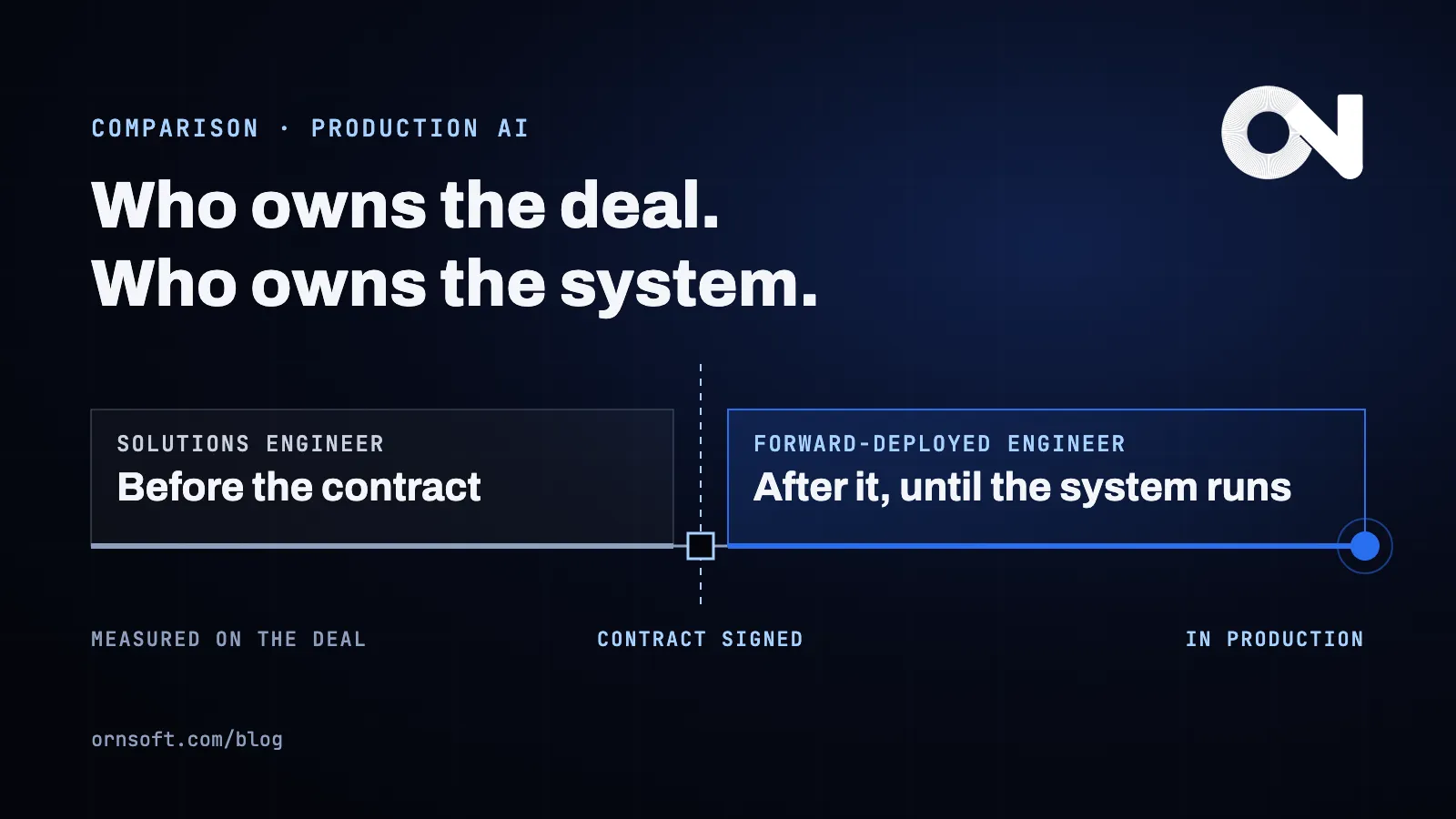
Forward-deployed engineer vs solutions engineer comes down to one word: ownership. A solutions engineer owns the technical side of a sale, until the contract is signed. A forward-deployed engineer owns what comes after: getting the system to run in production, in the customer’s environment, and staying accountable until it does.
Key takeaways
- The signature is the hand-off point. AI deployments stall there when nobody owns what comes next.
- Before you sign, ask who owns deployment, by name.
A forward-deployed engineer is a senior engineer who works directly with a company’s business and technical teams and takes ownership of moving an AI system from pilot to production. A solutions engineer is a technical specialist who supports the sales process by matching a product to a buyer’s need before purchase.
The titles sound close, and many job posts blur them. Industry coverage, such as The Pragmatic Engineer’s look at forward-deployed engineering, notes how often the role now overlaps with solutions and consulting work. For a buyer, the difference decides who will be in the room when the system has to pass a security review or meet its success criteria.
What does a solutions engineer own?
A solutions engineer sits between the product and the buyer during the sale. The US Bureau of Labor Statistics files the job under sales: sales engineers sell products or services that require technical expertise. Solutions engineer, sales engineer and pre-sales engineer are common titles for this pre-sale work.
Typical responsibilities:
- Understand the buyer’s requirements and technical environment.
- Show the product and answer technical questions.
- Scope a proof of concept and show that the product fits.
- Prepare the technical part of proposals and security questionnaires.
- Hand the account to delivery or customer success once the contract is signed.
Their success is measured on the deal: technical wins, sales cycles, the fit between what was sold and what the product does.
What does a forward-deployed engineer own?
A forward-deployed engineer starts where the solutions engineer’s job usually ends. Their work happens in the customer’s codebase and target environment, and covers what stops pilots from reaching production:
- Integration with live systems, data, identity and permissions.
- Security review, with data flows, hosting and access documented.
- Measurement, with an evaluation set built with the owners.
- Approvals, with gates on the actions that matter and an audit log.
- Ownership through deployment and adoption, then a documented handover.
Their success is measured on one thing: the system runs in production, and the customer’s team runs it. Analysts describe the same shift of work: Forrester counts absorbing integration risk among the core jobs of a forward-deployed engineer. For the full definition from the buyer’s side, see what a forward-deployed engineer is and does.
Put the two lists in sequence and the hand-off becomes visible:
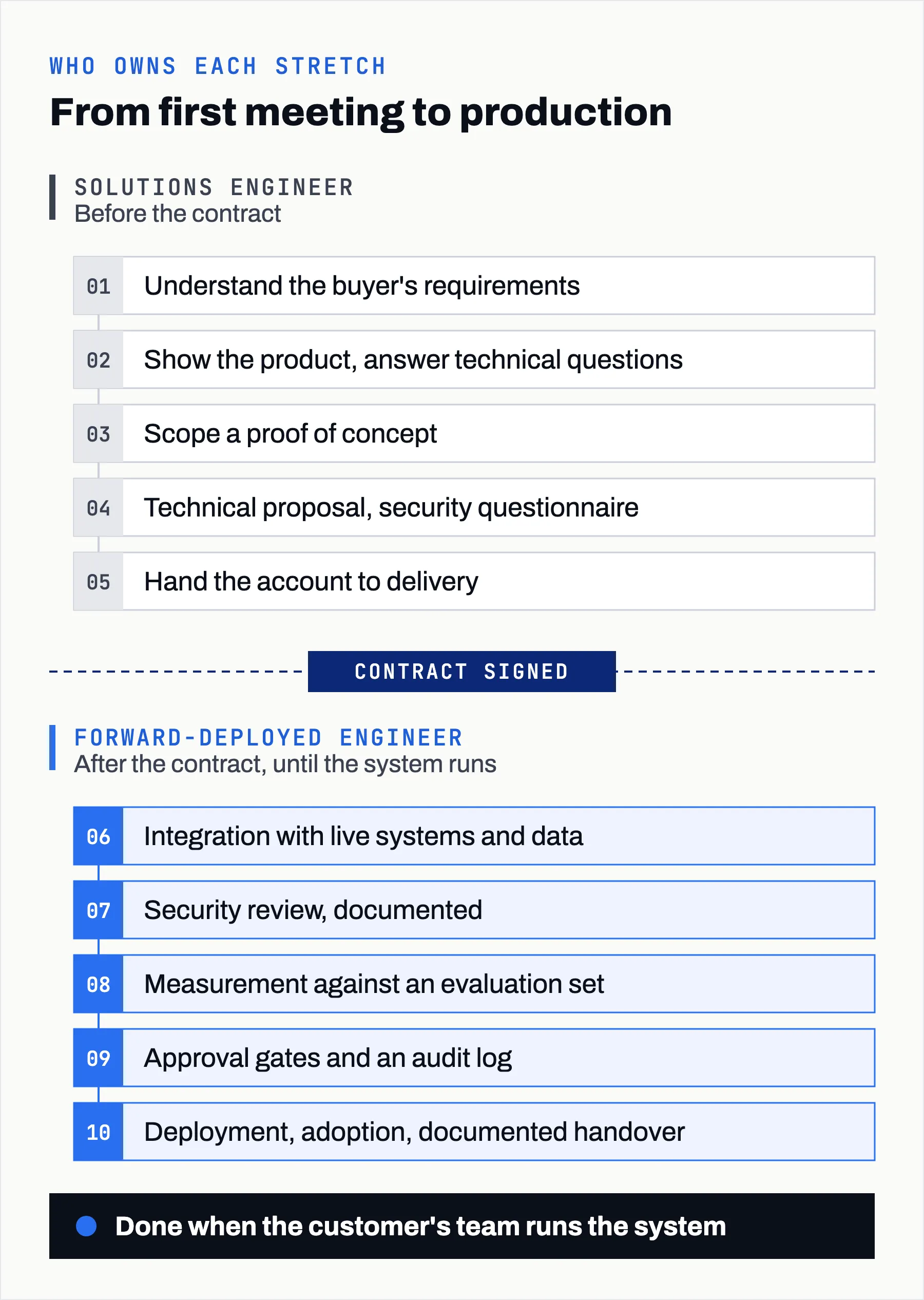
Forward-deployed engineer vs solutions engineer, side by side
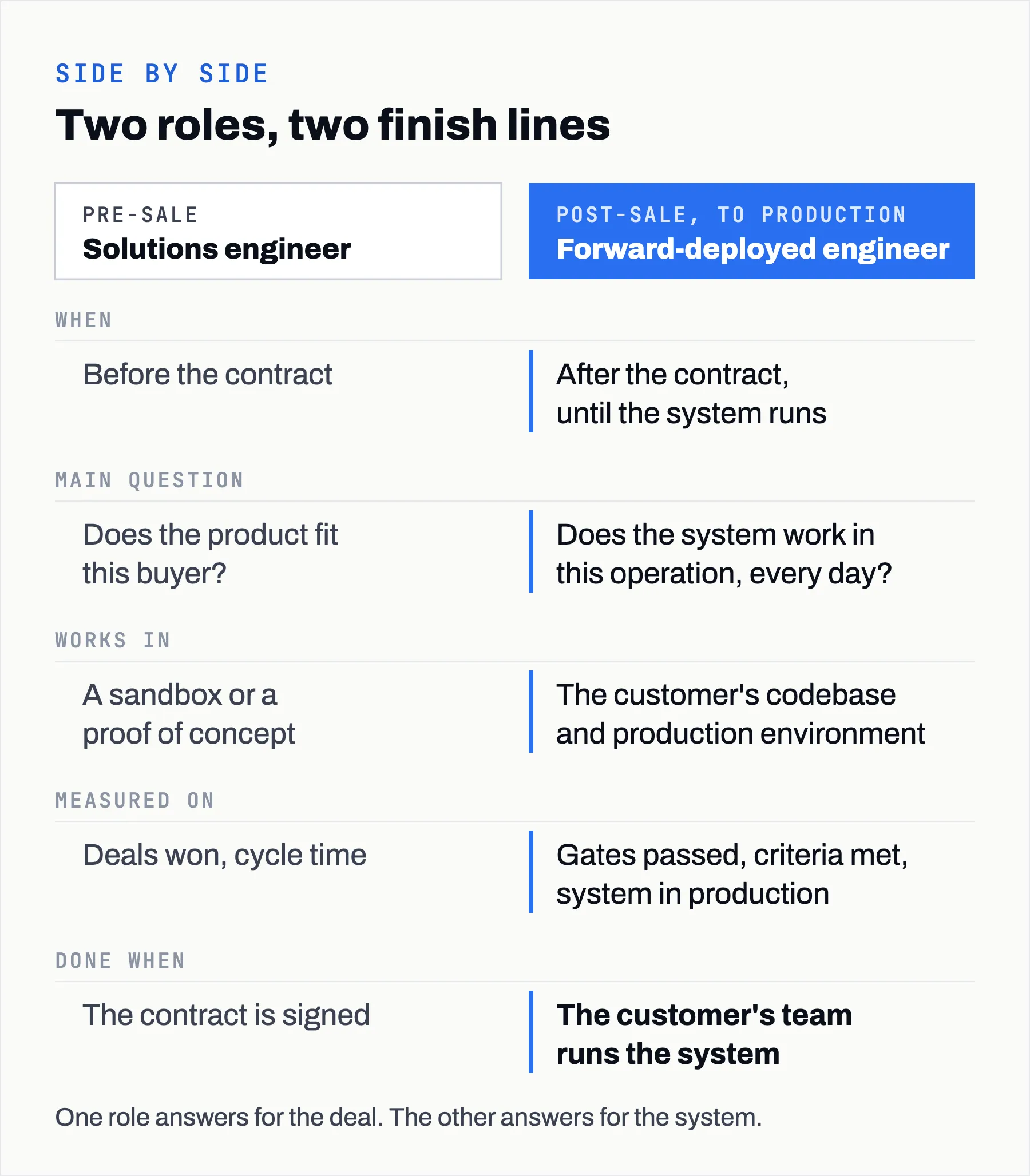
The full comparison:
| Solutions engineer | Forward-deployed engineer | |
|---|---|---|
| When | Before the contract | After the contract, until the system runs |
| Main question | Does the product fit this buyer? | Does the system work in this operation, every day? |
| Works in | The vendor’s environment, a sandbox or a proof of concept | The customer’s codebase and target production environment |
| Counterparts | Buyer, evaluators, procurement | Accountable business and technical owners, security, end users |
| Output | A technical win, a scoped proposal | Working integrations, security file, evaluation report, approval matrix, runbook |
| Measured on | Deals won, cycle time | Gates passed, criteria met, system in production |
| Done when | The contract is signed | The customer’s team runs the system |
What about sales engineers and solutions architects?
The same test applies to every title: who is accountable once the system has to run on live data, and what are they measured on?
- Sales engineer, pre-sales engineer. Usually other names for the solutions engineer’s pre-sale job.
- Solutions architect. Usually designs how the product should fit the customer’s environment. Depending on the company, the role sits before the sale, after it, or across both.
Why does the difference matter after the sale?
AI is easy to demo. Production is the hard part.
A proof of concept shows that a model can do the task on a clean sample. Production asks whether the operation can rely on it every day, on live data, under the rules that apply, with someone answerable for the result. That second question is never settled during the sale. It is settled in the customer’s environment, by someone who owns it.
Recognized frameworks treat that work as ongoing. The NIST AI Risk Management Framework makes measuring and monitoring an AI system’s risks one of its core functions, and ISO/IEC 42001 sets requirements for an AI management system that is maintained and continually improved. Neither is satisfied by a proof of concept.
When nobody owns it, the familiar pattern follows:
- The solutions engineer moves to the next deal.
- The product team returns to the roadmap.
- The deployment waits for a security answer or an integration that nobody is assigned to.
Which role do you need?
It depends on where you are:
| Your situation | The role that fits |
|---|---|
| You are evaluating products and need to know if one fits | Solutions engineer, from the vendor |
| You are an AI company that has sold an enterprise customer and must deliver | Forward-deployed engineer |
| You have an AI pilot that works but has stalled before production | Forward-deployed engineer |
| Your operation has outgrown its patchwork of tools and needs one platform | A platform build, scoped in writing |
The last row is a different need. When AI needs the system around it, we build that too: see Platform builds.
What should you ask before the contract is signed?
If you are the buyer, ask the vendor three questions while the solutions engineer is still in the room:
- Who owns deployment after the signature, by name? A team or a ticket queue is an answer to a different question.
- What does “in production” mean for this contract, in writing? Scope, success criteria, evaluation set, security, approvals and go-live date. Our one-page template to define production for an AI system lists every field.
- Who answers our security review, and when? Go-live waits until data flows, hosting and access are documented.
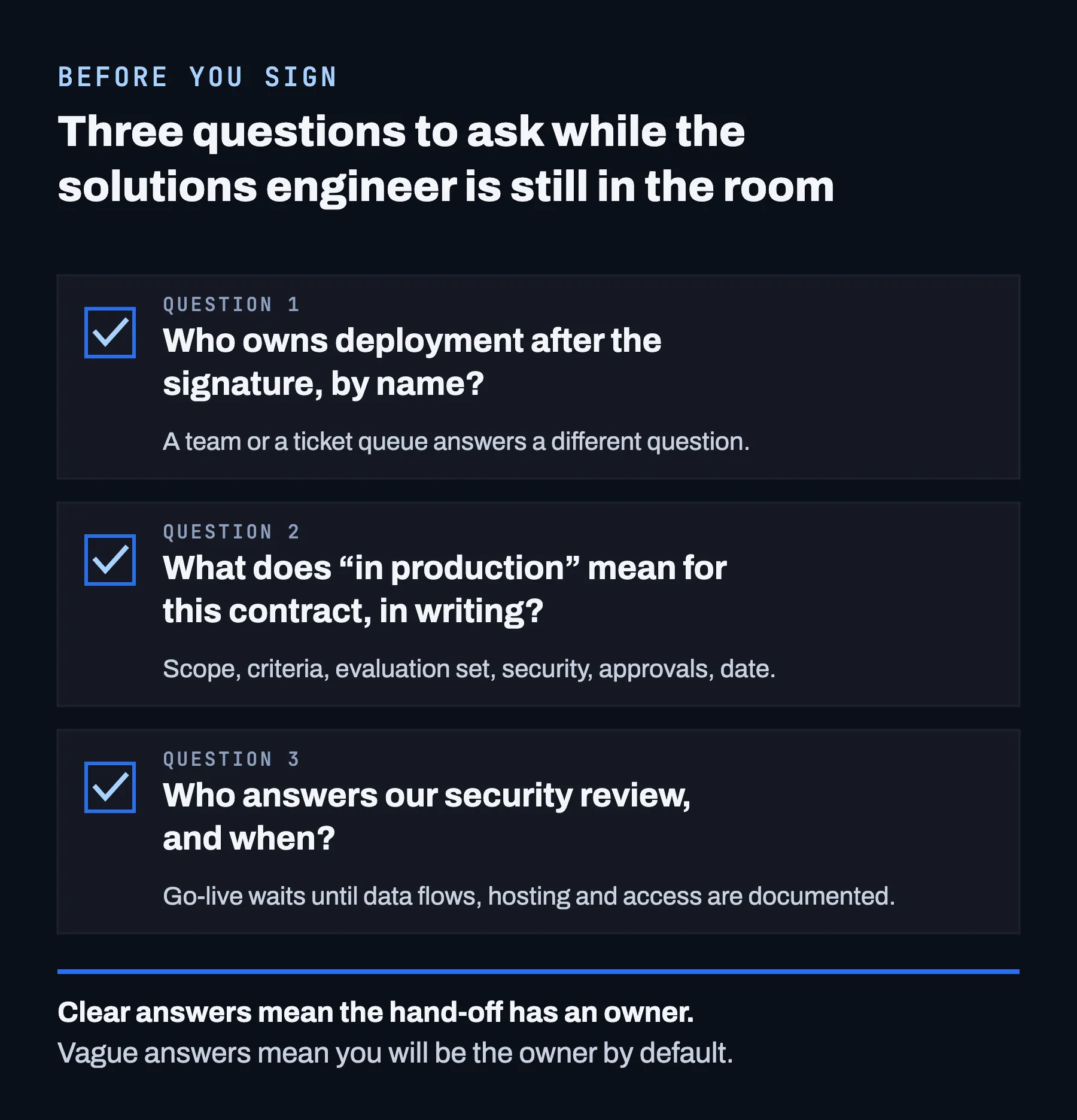
Clear answers mean the hand-off from sale to delivery has an owner. Vague answers mean you will be the owner by default.
How does OrNsoft approach forward-deployed work?
OrNsoft is an advanced AI engineering firm, founded in Florida in 2009, with applied AI in its software since 2015. We build our own AI products and bring client AI systems from concept or pilot to production.
In our forward-deployed engineering engagements, the ownership questions are answered before the build starts:
- A named senior lead from the first week, responsible until it runs.
- A production definition signed in week two by the accountable business and technical owners. If we cannot write this page with you, we tell you the pilot is not ready for production.
- Weekly written progress against these gates, from diagnosis to the day your team runs the system.
- The project-specific code, integrations, evaluation assets and documentation we produce are yours.
For AI companies, this is the role that turns a signed enterprise customer into a live one, while your product team keeps building the product. The week-by-week shape is in how a forward-deployed engagement works.
What happens next?
If you have sold an enterprise customer and need the system live in their environment, or have a pilot that has stalled, book a call. One call is enough to know whether we can help.
Questions
- What is the difference between a forward-deployed engineer and a solutions engineer?
- The solutions engineer handles the technical part of the sale, up to the signature. The forward-deployed engineer takes over from there and stays until the customer's own team operates the system in production.
- Is a forward-deployed engineer a sales role?
- No. The pre-sale technical role is the solutions engineer, also called sales engineer or pre-sales engineer, measured on deals won. A forward-deployed engineer works after the contract and is measured on the system running in production.
- How is a forward-deployed engineer different from a solutions architect?
- A solutions architect usually designs how a product should fit a customer's environment. A forward-deployed engineer builds it and stays accountable until it runs in production.
- Can a solutions engineer do forward-deployed work?
- Some can, but the two jobs pull in different directions. Pre-sales work follows the deal calendar; production work follows the operation's calendar. When one person carries both, the open deals usually win and the deployment waits.
- Does a forward-deployed engineer write code?
- Yes. They work in the client's codebase and target production environment, and the integrations, evaluation assets and documentation they produce stay with the client.
- Which role does an AI company need after its first enterprise sale?
- Both, in sequence. The solutions engineer helped win the customer. A forward-deployed engineer gets the system running in the customer's environment, through their security review, measured against criteria their owners signed.
Bring us the problem.
Book a call