
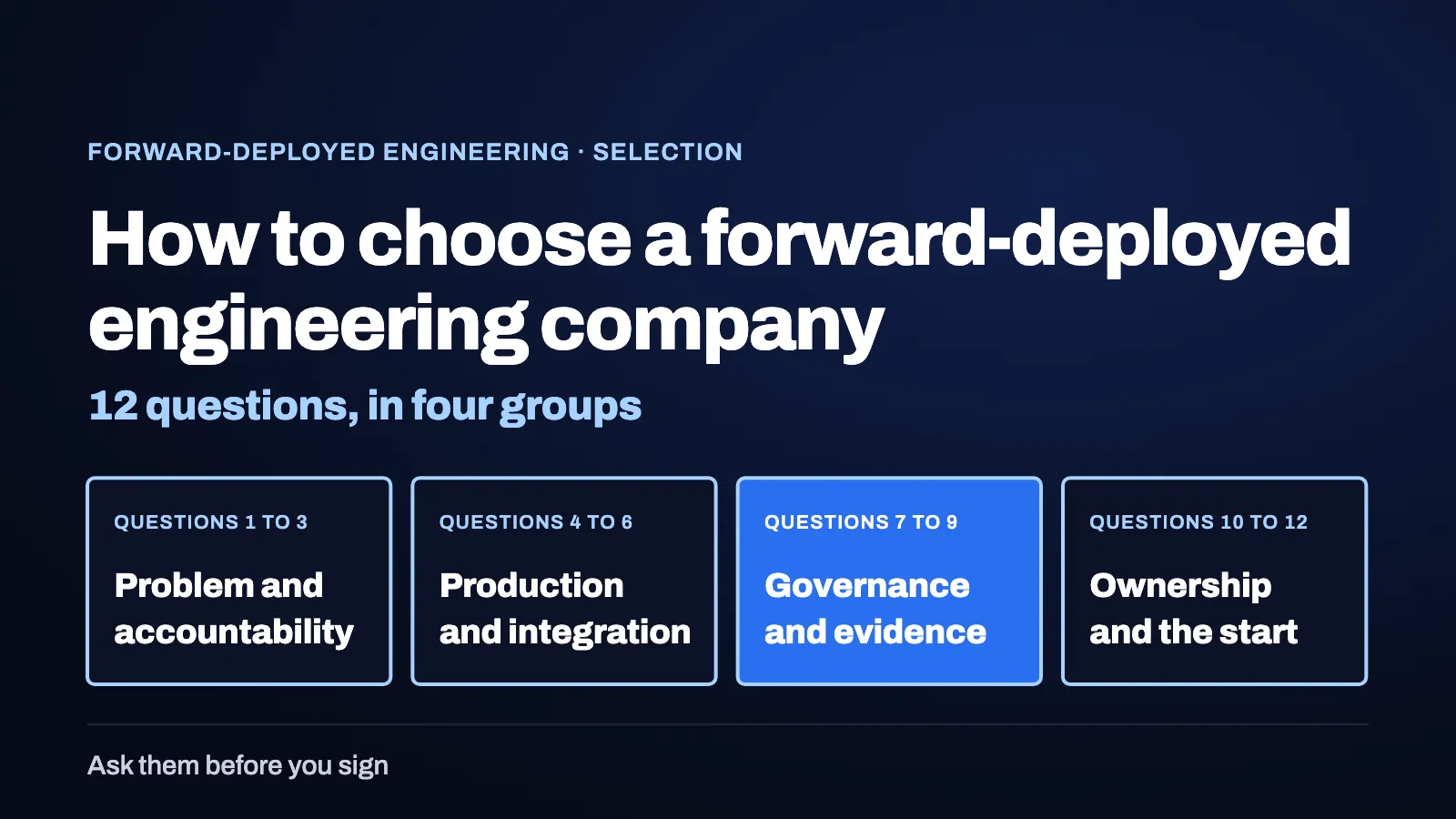
To choose a forward-deployed engineering company, ask it twelve questions that test four things: who owns your problem, what production means, how the system is governed, and what you own and see at the start. A forward-deployed engineering company puts its engineers to work directly with your business and technical teams, to move an AI system from pilot to production. The answers show, before you sign, whether that will really happen.
A forward-deployed engineering company is a partner whose engineers learn how your operation actually runs, decide what has to be built, and stay accountable until the system runs in production.
This article is for operators who have an AI pilot that has stalled, or a process that AI should change, and who are comparing partners. It gives you twelve questions, what a good answer sounds like, and a scorecard to mark what you hear. If you are still deciding whether this model fits your situation, start with why AI pilots stall.
Key takeaways
- Start from the problem. The first answer should be about your operation, not about a tool or a statement of work.
- Look for a named person. One senior lead, responsible until the system runs, is the signal to look for.
- Ask for production in writing. If a partner cannot define production on one page, the pilot will stall again.
- Ask about governance early. Approval gates, evaluation and records are easier to design before go-live than after.
- Check what you own. Code, modules and data should be yours at the end, and you should know what you will see in the first 30 days.
What is a forward-deployed engineering company?
The model is simple to state. Engineers work directly with your business and technical teams. They learn how your operation really runs, work out what has to be built, and carry the system from pilot to production. You explain the objective once. The distinction from other kinds of partner is in who is accountable and for how long. The model is described in more depth in what forward-deployed engineering is, and the way an engagement runs is in how a forward-deployed engagement works.
Because the model is built on responsibility, the questions below are about responsibility. They are the questions you would ask anyone who is going to carry part of an operation for you.
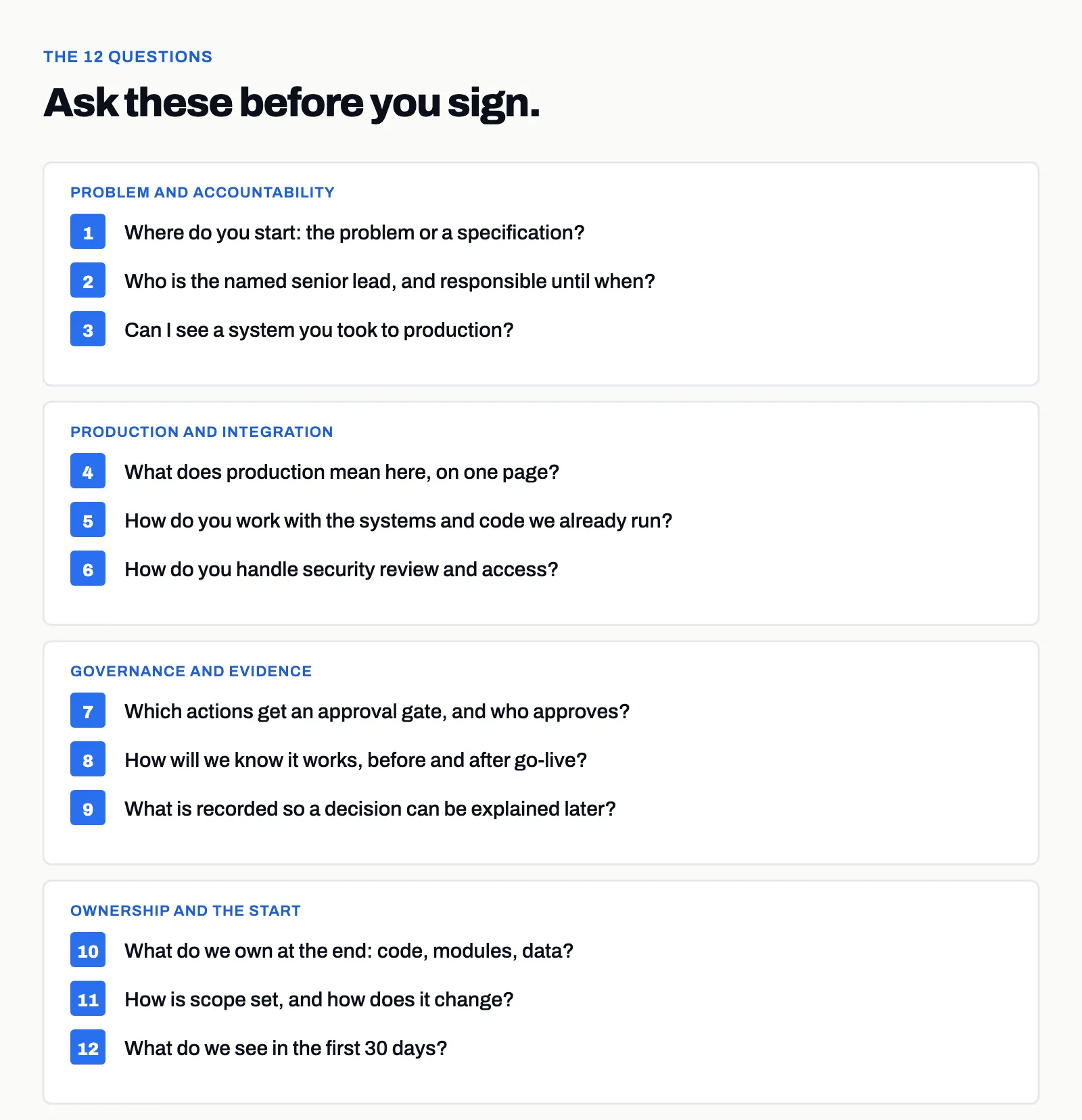
Which questions test the problem and the accountability?
1. Where do you start: the problem or a specification? A good answer starts with your operation: what is slow, costly or risky today, and what a better result looks like. Our own position is “Bring us the problem, not the specification.” A warning sign is an answer that asks you for a complete requirements document first.
2. Who is the named senior lead, and responsible until when? You want one person, with a name, accountable until the system runs. A good answer names the role, says how often you will speak to that person, and says what happens if they change. A warning sign is “the team” with no individual.
3. Can I see a system you took to production? Ask for a reference you can speak to, and ask what was running, for whom, and since when. Client results should be told by the client. Our own references show how we present ours.
Which questions test production and integration?
4. What does production mean here, on one page? A good partner writes scope, criteria, evaluation, security, approvals and go-live on one page before building, and has you and your technical owner sign it. The method is in define production for an AI system. A warning sign is “we will know it when we see it.”
5. How do you work with the systems and code we already run? The system has to connect to what your operation already uses. A good answer names how the partner reads your existing systems, works with your codebase, and what it needs from your technical team. A warning sign is a plan that assumes a clean start in a separate environment.
6. How do you handle security review and access? Security review is one of the five open decisions that stall pilots. A good answer says who needs access to what, how it is granted and removed, and when your security team sees the design. A warning sign is leaving security review to the end.
Which questions test governance and evidence?
7. Which actions get an approval gate, and who approves? A good answer sorts actions by consequence, gates the irreversible or external ones, and names an approver with a backup for each. It also says what happens when nobody answers. We cover this in approval gates for sensitive automated actions.
8. How will we know it works, before and after go-live? Ask what is measured, on what examples, and who reads the result. A good answer includes a test set built from your own cases, and a plan for checking quality once real traffic arrives. See how to evaluate AI agents for what that looks like. A warning sign is “it looked good when we showed it.” NIST’s AI Risk Management Framework organises AI risk work in four functions: govern, map, measure and manage.
9. What is recorded so a decision can be explained later? For sensitive decisions you want the input, the model and version, the output, the action and the approver, in time order. A good answer treats this as a requirement written before go-live. The detail is in what an AI audit trail is, which we cover in a separate article.
Which questions test ownership and the start?
10. What do we own at the end: code, modules, data? The answer should be in plain words and in the contract. A good answer says your custom code, modules and data stay yours. A warning sign is an answer that depends on a license you have not seen.
11. How is scope set, and how does it change? Ask how work is scoped, who agrees changes, and what you see before you agree. A good answer ties scope to the production page from question 4, so a change is a visible decision. A warning sign is scope that grows without a named approver.
12. What do we see in the first 30 days? A good answer lists what you will have: for example a written definition of production, a first working slice in your environment, and a decision you can make with them. See what the first 30 days look like. A warning sign is a first month of “discovery” with nothing you can inspect.
How do you score the answers when you choose a partner?
Mark each answer clear, partial or missing. Clear means the partner gave a specific answer about your operation. Partial means the answer was correct in general but not specific to you. Missing means there was no answer, or the partner moved to another topic.
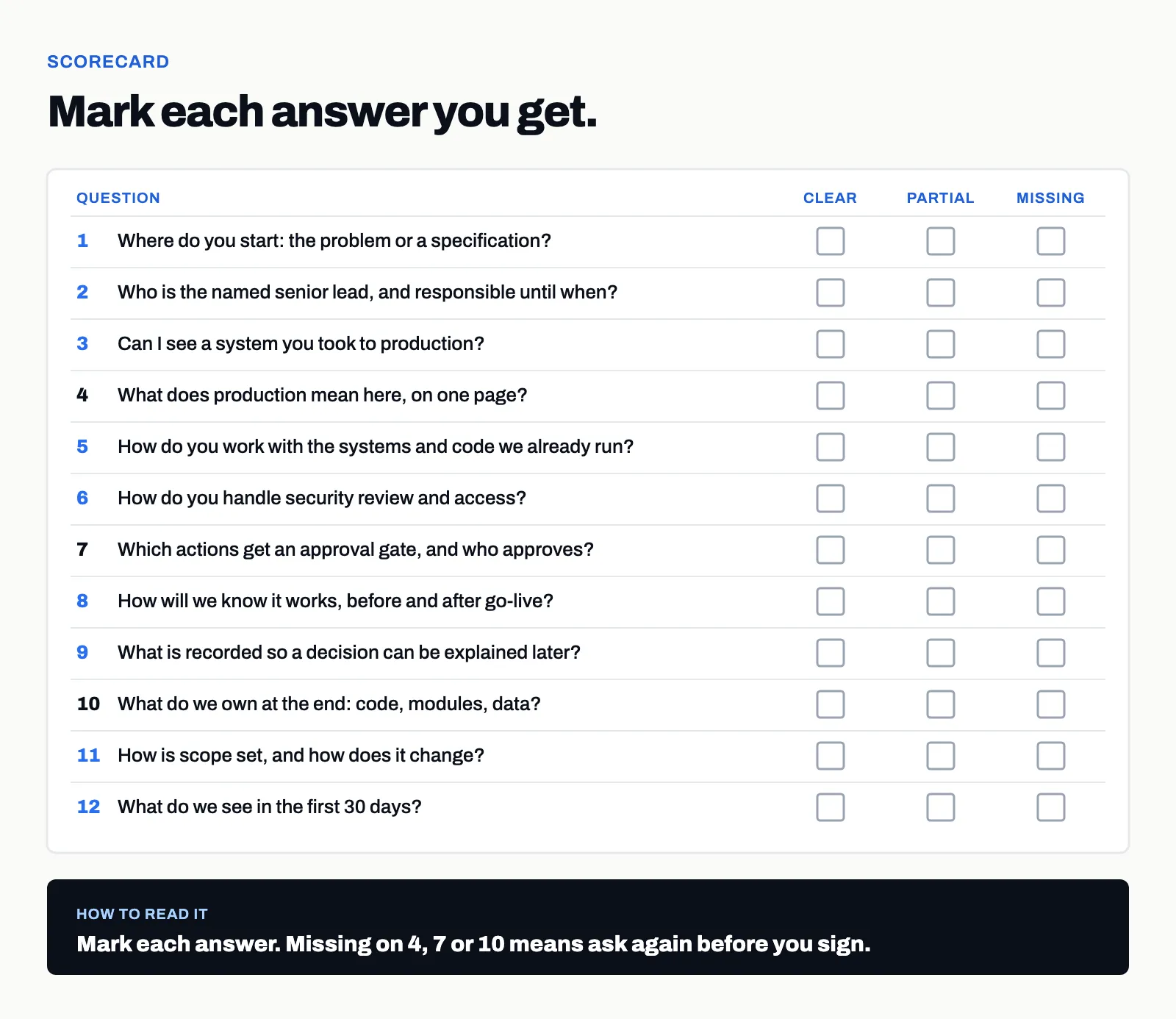
Two rules help. First, treat a missing answer on production (question 4), approvals (question 7) or ownership (question 10) as a reason to ask again before you sign, because these three are easier to settle before the build starts than after. Second, compare partners on the same scorecard, and have your business owner and your technical owner mark it separately. Where their marks differ, you have found a question to settle inside your own company.
What if your answers come out partial?
A partial answer is normal in a first conversation, because a partner who has not yet studied your operation cannot be specific about it. The test is whether they can say how they will find out. “We will map your approval path in the first two weeks, with your finance lead” is a partial answer with a plan. “We handle that” is not.
What should you do next?
Pick the three questions that matter most for your situation and ask them in your next conversation with any partner, including us. If your pilot is already stalled, start with questions 4, 7 and 10. If the move from pilot to production is the issue, our guide to AI pilot to production is the place to start. Our work is described on the forward-deployed engineering page, and the standard for how we frame trust is in AI trusted by design.
Bring us the problem, not the specification. Book a call. One call is enough to know whether we can help.
Questions
- What is a forward-deployed engineering company?
- A company whose engineers work directly with your business and technical teams, learn how your operation runs, decide what has to be built, and move the system from pilot to production.
- How do I choose a forward-deployed engineering company?
- Ask twelve questions in four groups: who owns the problem, what production means, how the system is governed and evidenced, and what you own and see in the first 30 days. Score each answer clear, partial or missing.
- What should I ask before signing?
- Ask who the named senior lead is and until when they are responsible, what production means on one page, which actions need approval, how quality is measured after go-live, and what you own at the end.
- What is a warning sign in an answer?
- An answer about tools and not about your operation, no named person who is responsible, no written definition of production, or no answer about who owns the code and data at the end.
- Can I run a small test first?
- Yes. Ask what a first engagement would deliver in 30 days and how you will judge it. A good partner can say what you will see, and what decision it lets you make.
- Who should be in the room when I ask these questions?
- The business owner who answers for the process, and the technical owner who runs the systems around it. Both should hear the same answers.
Bring us the problem.
Book a call