
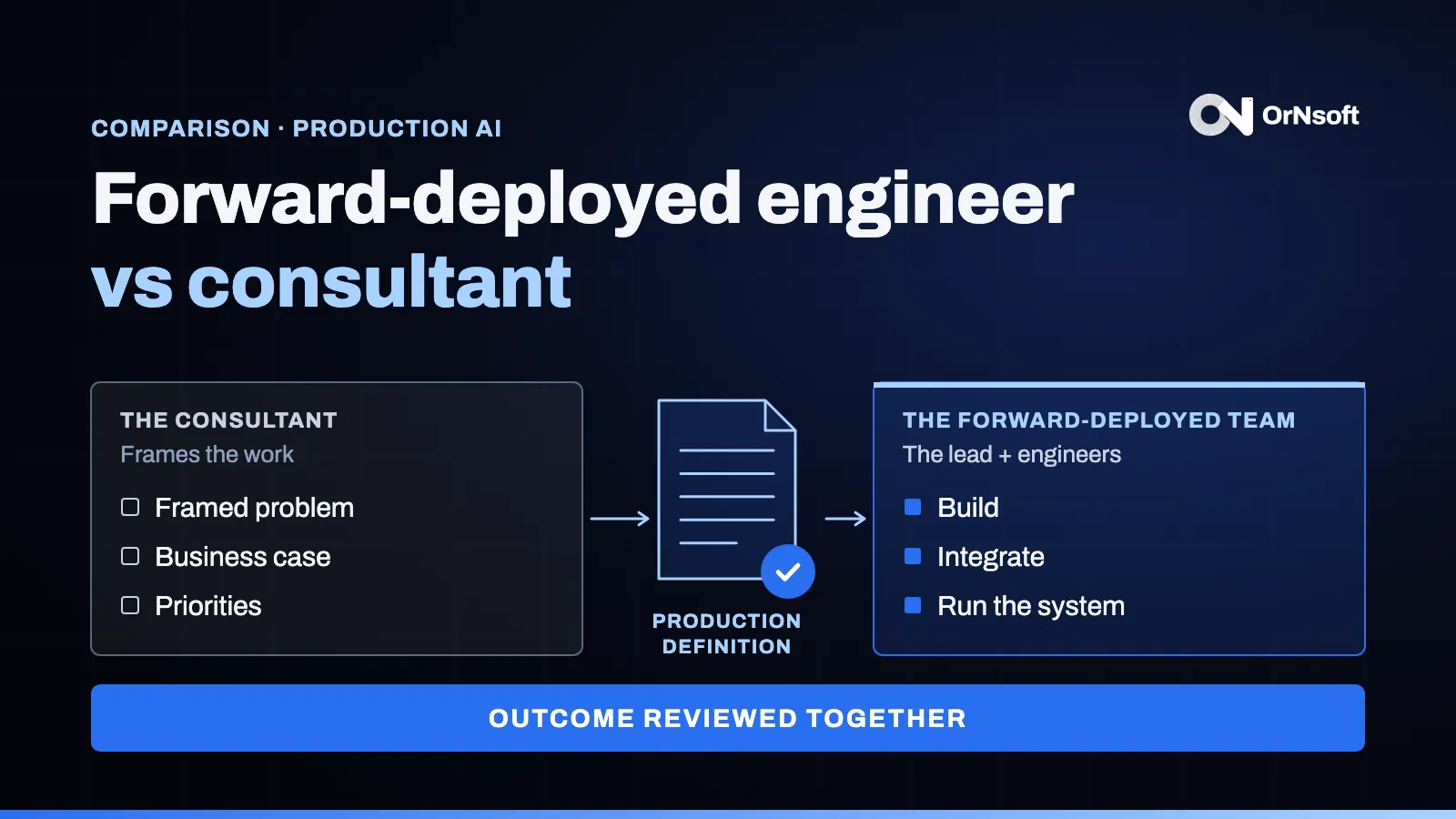
Forward-deployed engineer vs consultant is not an either-or: the two work on different stages of the same AI project. The consultant frames the problem, the business case and the priorities. The forward-deployed team builds the system, connects it to your systems and runs it until it works in production. The main difference is what each one answers for: the consultant for the quality of the advice and the plan, the forward-deployed team for a system that runs against criteria agreed before the build.
A forward-deployed engineer is an engineer who works directly with the client’s business and technical teams, determines what has to be built, and takes ownership until it runs.
Buyers often meet both on one project, sometimes in the same week. This article sets out how the work splits, so the hand-off is clean and nobody’s work is repeated. For the model as a whole, see forward-deployed engineering: what it is, how it works and when you need it.
Key takeaways
- Two jobs, one project. The consultant answers what to do and why. The forward-deployed team makes it run.
- Advice or outcome. The consultant answers for the plan. The forward-deployed team answers for the result, against signed criteria.
- The consultant stays the trusted advisor. The consultant and the client decide whether that continues through go-live.
- The hand-off is a written page. The consultant’s scope becomes a production definition signed by the client’s owners.
Forward-deployed engineer vs consultant: what is the difference?
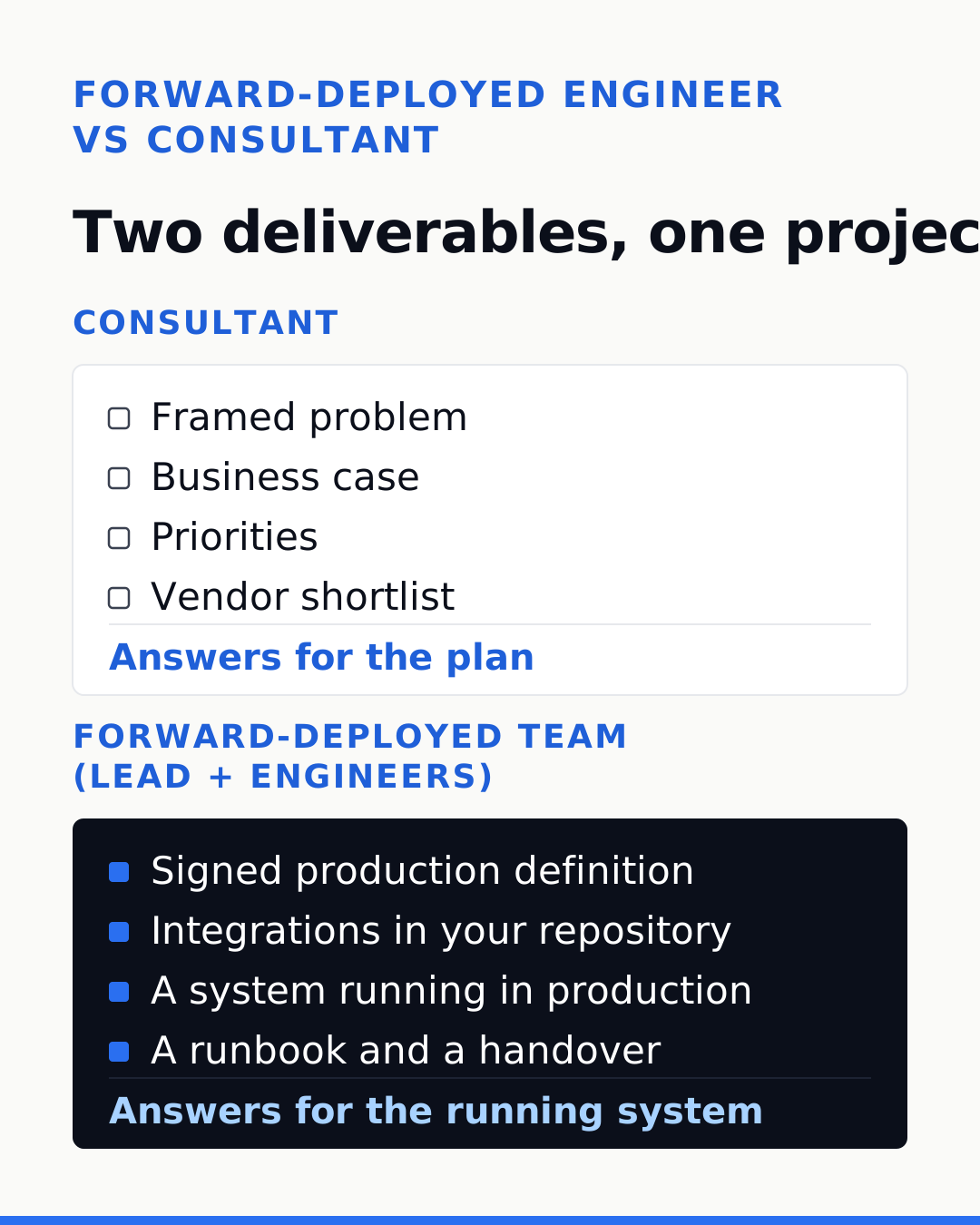
The difference is the deliverable, and what each one answers for. A consultant’s work usually ends in a recommendation the client can act on: a strategy, a business case, an operating model, a vendor choice. A forward-deployed engineer’s work ends in a system that runs, with code in the client’s repository and owners who can check it against agreed criteria.
| Dimension | Consultant | Forward-deployed team |
|---|---|---|
| Main deliverable | A recommendation and a business case | A working system in production |
| Who writes the code | Usually not the consultant | The engineers, in the client’s repository |
| Integration with your systems | Specifies what should connect | Builds and tests the connections |
| Definition of done | Frames the objective and priorities | Writes the production definition with the owners |
| After go-live | Advisor to the client, if retained | Accountable until the system is handed over |
| Answers for | The quality of the advice and the plan | A system that runs, against the signed criteria |
| How success is measured | The business case and its milestones | Results against the signed criteria |
The two columns are complements. A project that has only the left column ends with a good plan and no system. With only the right column, the risk is building the wrong thing well.
Who are the two roles on a forward-deployed project, and what is the forward-deployed team?
A forward-deployed engagement has two roles.
- Forward-deployed engineer. The technical role: builds, integrates and runs the system in the client’s repository.
- Forward-deployed lead. The senior lead accountable for the business outcome, working with the forward-deployed engineers from problem to production. The lead works with the client’s owners, and with a consultant when there is one, on the production definition and the outcome review.
The forward-deployed team is not a third role. It is what the client gets: the lead and the engineers working as one unit on one engagement. A team can be the lead alone, or the lead together with forward-deployed engineers, depending on what the engagement needs.
The consultant is a separate party. The consultant frames the problem and keeps the strategic thread with the client. The forward-deployed team makes the recommendation run. What the engineer’s role covers on its own is set out in what is a forward-deployed engineer.
Who does what, stage by stage?
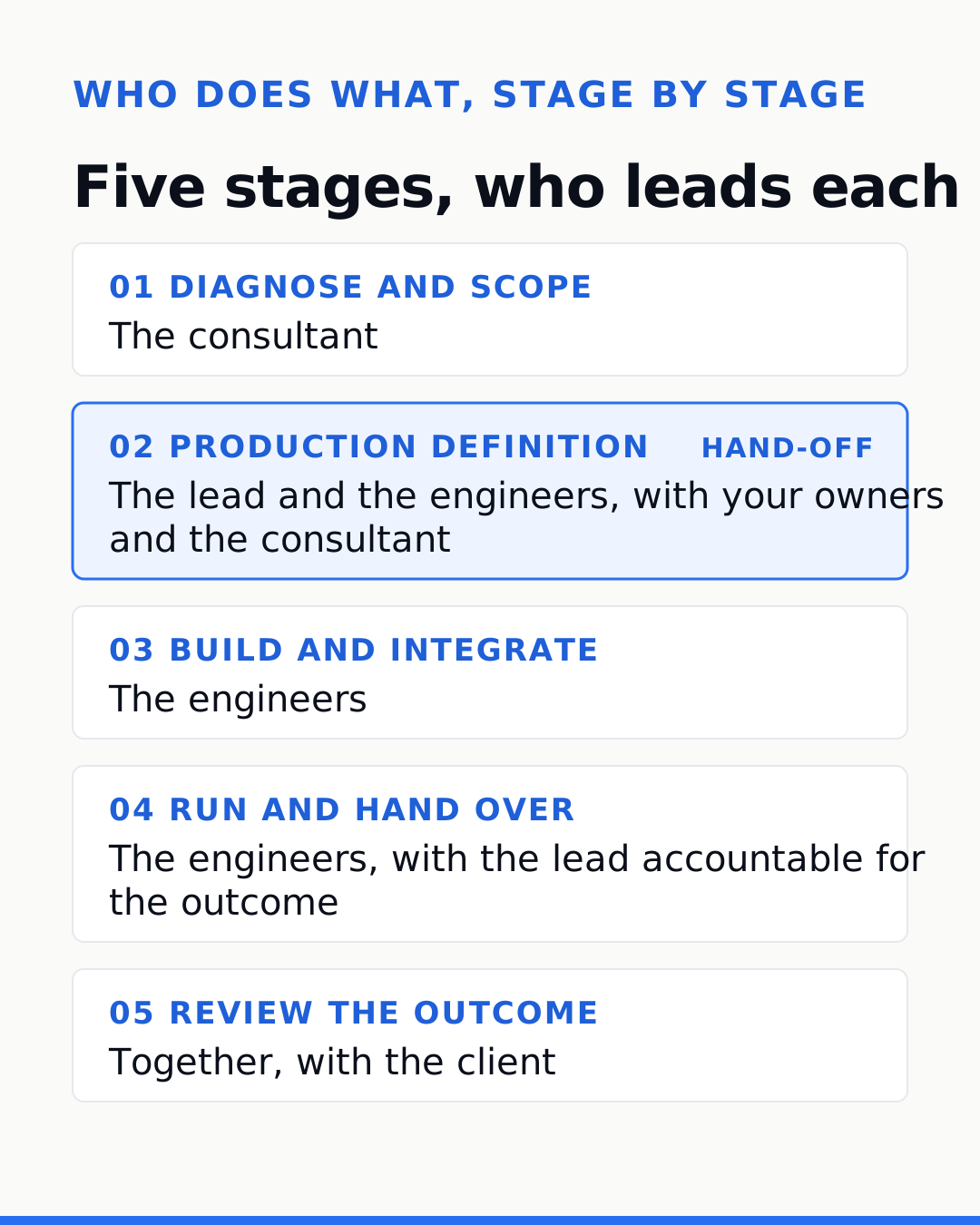
When a consultant brings a project to us, the stages split like this:
| Stage | Who leads | What the client gets |
|---|---|---|
| Diagnose the business problem and scope it | The consultant | A framed problem, a business case, priorities |
| Turn the scope into a production definition | The forward-deployed lead and engineers, with the client’s owners and the consultant | One signed page that defines done |
| Build and integrate | The forward-deployed engineers | Working integrations in the client’s repository |
| Run it in production and hand over | The forward-deployed engineers, with the lead accountable for the outcome | A system that runs, a runbook, a documented handover |
| Review the outcome | Together, with the client | Results against the agreed criteria |
The consultant’s work stops where the engineering starts, and the production definition is the page that passes the baton. How that page is written, week by week, is covered in how a forward-deployed engineering engagement works.
What happens to the consultant’s role after the hand-off?
The client signs with OrNsoft. The consultant framed the problem and the business case, often over months of trust. Our job is narrower: take ownership of getting the system into production and running it. The consultant either stays as the client’s trusted advisor through go-live, or hands over cleanly once the system runs. The client and the consultant choose.
Public frameworks ask for the same clarity about who answers for what. The NIST AI Risk Management Framework puts accountability under its Govern function, and the NIST AI RMF Playbook lists suggested actions for defining roles and responsibilities. The OECD AI Principles list accountability among their values-based principles. A project with two kinds of experts meets that bar only if the hand-off is written down.
When is a consultant the right first call?
When the question is still what to do. Which process to automate first, whether the business case holds, how teams and roles should change, which vendors to shortlist: these are consulting questions, and answering them well saves engineering time later.
When are forward-deployed engineers the right call?
When the decision is made and the system has to run. That is the work of forward-deployed engineering. A pilot that works on examples but has to reach live data, pass a security review, be measured against agreed criteria and be adopted by the people who use it needs engineers who build it and stay accountable.
The work does not end at the first release. Google researchers found it “common to incur massive ongoing maintenance costs in real-world ML systems” (Hidden Technical Debt in Machine Learning Systems, NeurIPS 2015). That is why the forward-deployed team stays accountable until the system is handed over with its runbook.
Can you use both?
Yes. The consultant keeps the strategic thread with the client, and the forward-deployed team makes the recommendation run in production. The production definition is where the two meet.
What should you do next?
If you have a recommendation that now has to run, book a call. One call is enough to know whether we can help. If you are a consultant whose clients need their AI to reach production, you can introduce us, present our work and support your clients through the project: see how our network works.
Questions
- What is the difference between a forward-deployed engineer and a consultant?
- What each one answers for. A consultant answers for the quality of the advice and the plan. A forward-deployed team answers for a system that runs in production, against criteria agreed with the client before the build.
- What is the difference between a forward-deployed engineer and an implementation consultant?
- An implementation consultant usually configures and rolls out an existing product. A forward-deployed engineer writes and integrates the code a specific AI system needs, then answers for it until go-live.
- Is a forward-deployed team accountable for hours or for results?
- For the outcome. The team answers for a system that runs against the criteria agreed in the production definition, not for the number of hours spent.
- Who is the forward-deployed lead?
- The senior lead accountable for the business outcome, working with the forward-deployed engineers from problem to production.
- What is a forward-deployed team?
- Not a third role: it is the unit the client gets on an engagement, the lead alone, or the lead together with forward-deployed engineers.
- Should we start with a consultant or with forward-deployed engineers?
- Start with whichever question is open. If you are still deciding which problem to solve, talk to a consultant. If the decision is made and a system has to run, bring in engineers.
Bring us the problem.
Book a call