
If you are about to launch an app built with AI tools, here is how we work. Before we ask a team to check what a stranger can see in their app, we run the same check on our own. This page shows two checks on a demo app we built for the purpose, called Acme Orders. The data is invented: six made-up customers with example addresses. Nothing here comes from a client.
What you can take from this page
- A check you can run in ten minutes. Open the app in a private window, sign in as nobody, and see what comes back.
- A drill you can ask for. Delete one record, restore from the backup into a separate copy, and compare.
- Honest limits. A small demo shows the method, not your result.
Check 1: what does a stranger see?
We opened the first version of Acme Orders as a stranger. The steps take about ten minutes on your own app, if you own it or are authorized to test it, with test data:
- Open a private browser window and do not sign in.
- Open the app and the browser’s network panel, then reload.
- Find the request the page makes for its data.
- Look at what came back.
On the first version, the answer was every customer’s name and email.
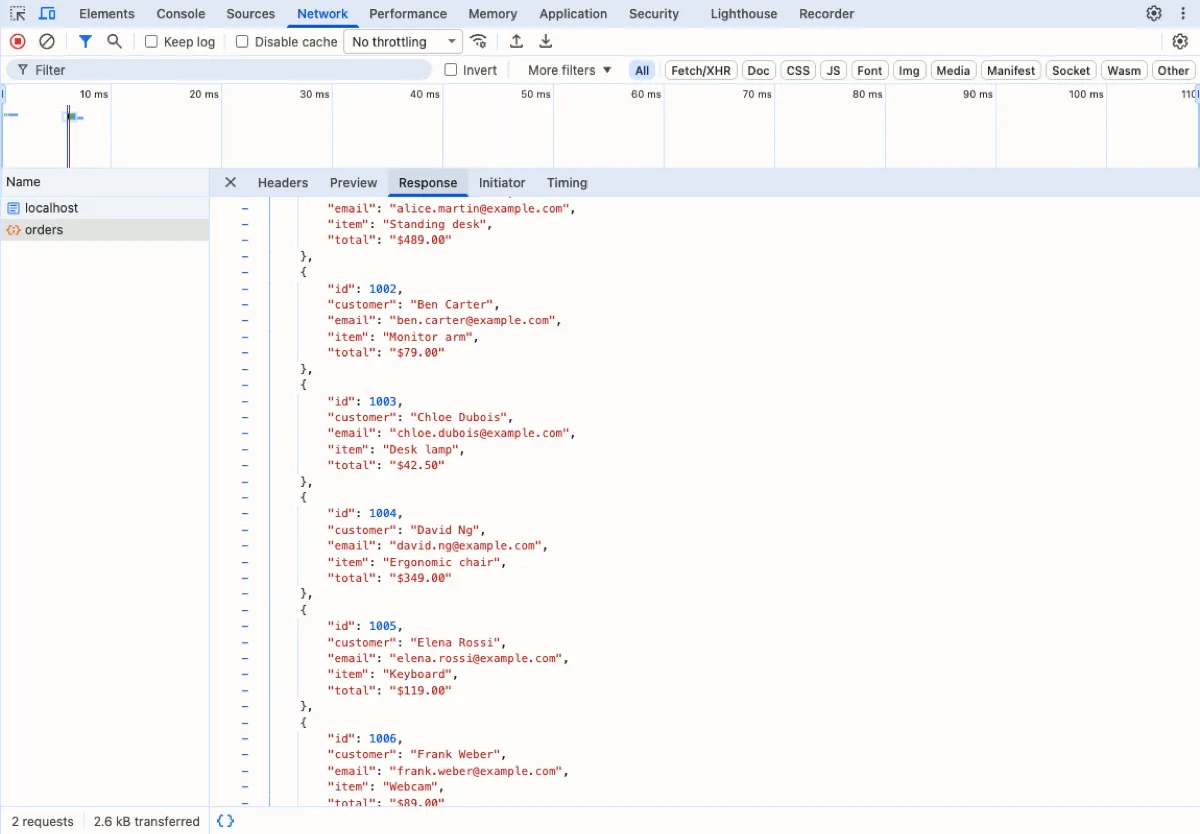
Our own demo app, invented data: with no sign-in, the response lists every customer’s name and email.
That is the answer that should stop a go-live. A clean-looking page is not a pass, because the page shows only what the app chooses to display. The pass is what the server hands to someone who asks without a login. After we closed that gap, the same request came back as 401 Unauthorized with an empty response.
Check 2: can you restore what you lose?
A backup you have never restored is a hope. So we ran a drill, and wrote down the clock times as they happened:
- We took a backup of the demo app. It held six customers, six orders and a known order total.
- We deleted one customer in the live app, as a person might by mistake. The live app now showed five.
- We decided to restore, and started the clock.
- We restored the backup into a separate copy, so the live app stayed untouched while we checked.
- We compared the copy with the backup on four points: the number of customers, the newest order, the order total, and the deleted customer. All four matched.
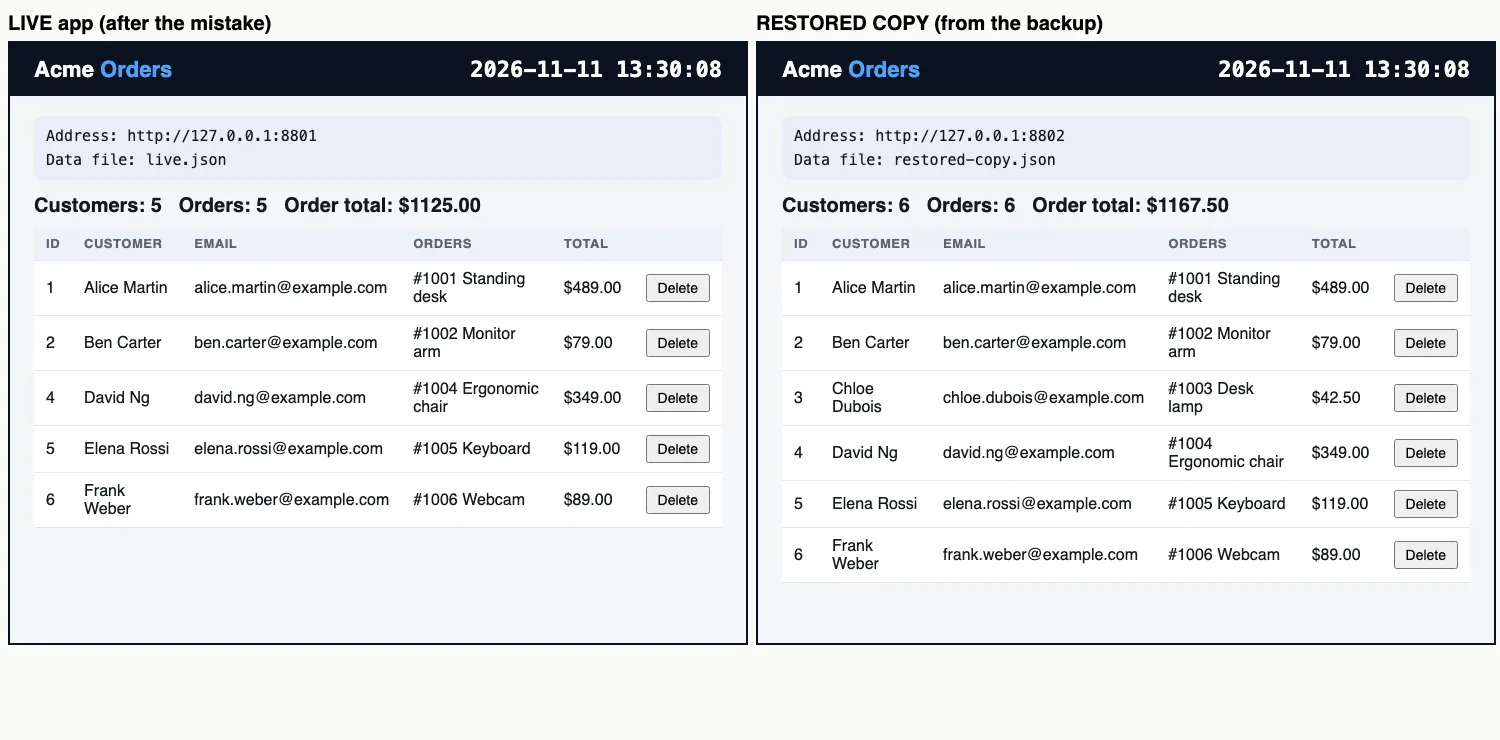
Left: the live demo after the mistake, five customers. Right: the restored copy, six customers.
What the drill shows, and what it does not
What the drill shows is the method. Take a backup. Lose something on purpose. Restore into a copy. Compare on points you chose in advance. Write down the times. That is what we ask of a real system.
The restore took 1.049 seconds, and about one second of that is a fixed pause our script waits for the copy to start. The demo is tiny, on one machine, with six records, and our script recorded the decision and the confirmation. The time says nothing about how fast yours would restore.
Neither check says an app is protected. They tell you what a stranger could read and whether a loss can be undone, on the day you ran them.
Why we show our own work first
Our go-live review looks at your app the way an outsider would: who can reach which data, what the server functions give away, where the keys live, and what happens when something fails. We think a team that asks you to look should be able to show what it found when it looked at itself first, including what it could not conclude.
Our go-live review is a fixed-price written review of your app before it goes to real users: a prioritized report that says what to fix first, and a one-hour readout with your team. To start, tell us about the app, the launch date and who signs.
Bring us the problem.
Book a call