
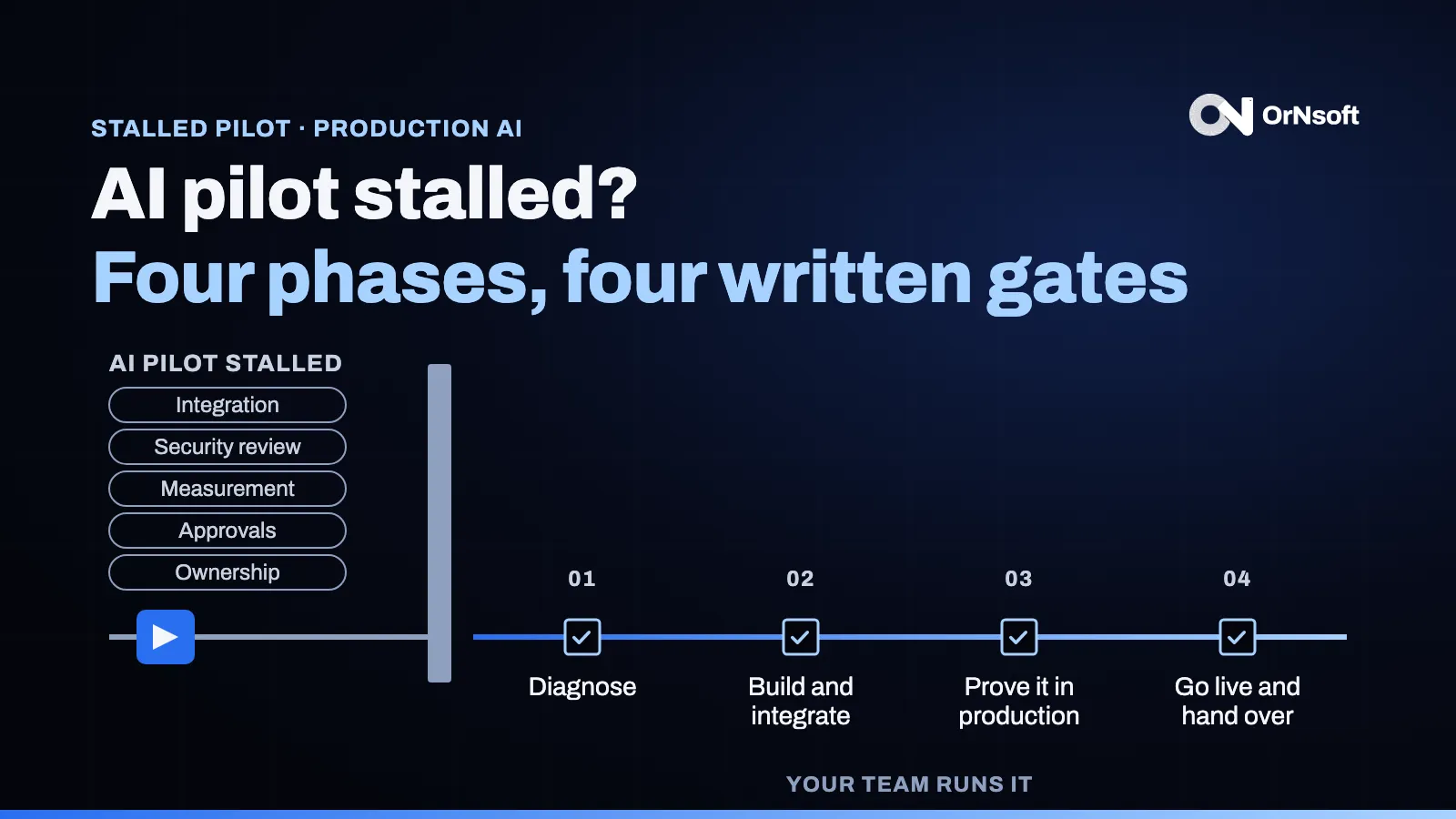
If your AI pilot has stalled, forward-deployed engineering restarts the work from the decisions nobody made. Engineers work directly with your business and technical teams, read the pilot you have, write down what production means on one page, then build, prove and hand over the system, with a written gate at each phase. For an operator, that means the pilot gets an owner and a path to production, instead of waiting for a new project.
Forward-deployed engineering for a stalled pilot means engineers who work directly with your business and technical teams, learn how your operation actually runs, determine what has to be built, and take ownership until the system runs.
AI is easy to demo. Production is the hard part. This article is for the people who answer for the operation: the COO, the head of operations, the owner of the business. It explains how to tell that a pilot has stalled, what a forward-deployed engagement does about it, and what you bring and receive. The model in general is described in forward-deployed engineering: what it is, how it works and when you need it.
Key takeaways
- A pilot stalls on decisions, not on the model. Five are usual: integration, security review, measurement, approvals and ownership.
- Four phases, four written gates. Each phase ends with something you can check.
- You bring two owners, access and real examples. The engineers do the rest with you.
- The first gate can be a “not yet”, in writing. Knowing early is a result, not a failure.
How do you know your AI pilot has stalled?
A stalled AI pilot works on the examples people tried. What is missing is a decision about how it reaches production. These are the signs, each tied to the decision that is open:
| What you see | Decision that is open |
|---|---|
| The pilot still impresses when shown, but the system runs on exported data or a limited environment | Integration with live systems |
| The go-live date moves, and the security review has not been completed | Security review |
| Every error reopens the debate about whether the system can be trusted | Measurement: no agreed meaning of good enough |
| Nobody can say which outputs a person must approve | Approvals |
| The people who built the pilot have moved on to other work | Ownership |
If rows like these describe your pilot, it has stalled. The same five decisions are explained in why AI pilots stall, and what moves them to production.
Why does an AI pilot stall in an operating business?
Because a pilot is built to show that something can be done, and production has to hold the whole operation around it. Google researchers made the point for machine learning in Hidden Technical Debt in Machine Learning Systems (NeurIPS 2015): real-world systems tend to incur large ongoing maintenance costs, and the model is only part of what has to be kept running.
In an operating business there is a second reason. The people who know how the work really happens and the people who build the system often work apart. The pilot is then built next to the operation, not inside it. Nobody is wrong; nobody was asked to own the gap.
What does forward-deployed engineering do for a stalled AI pilot?
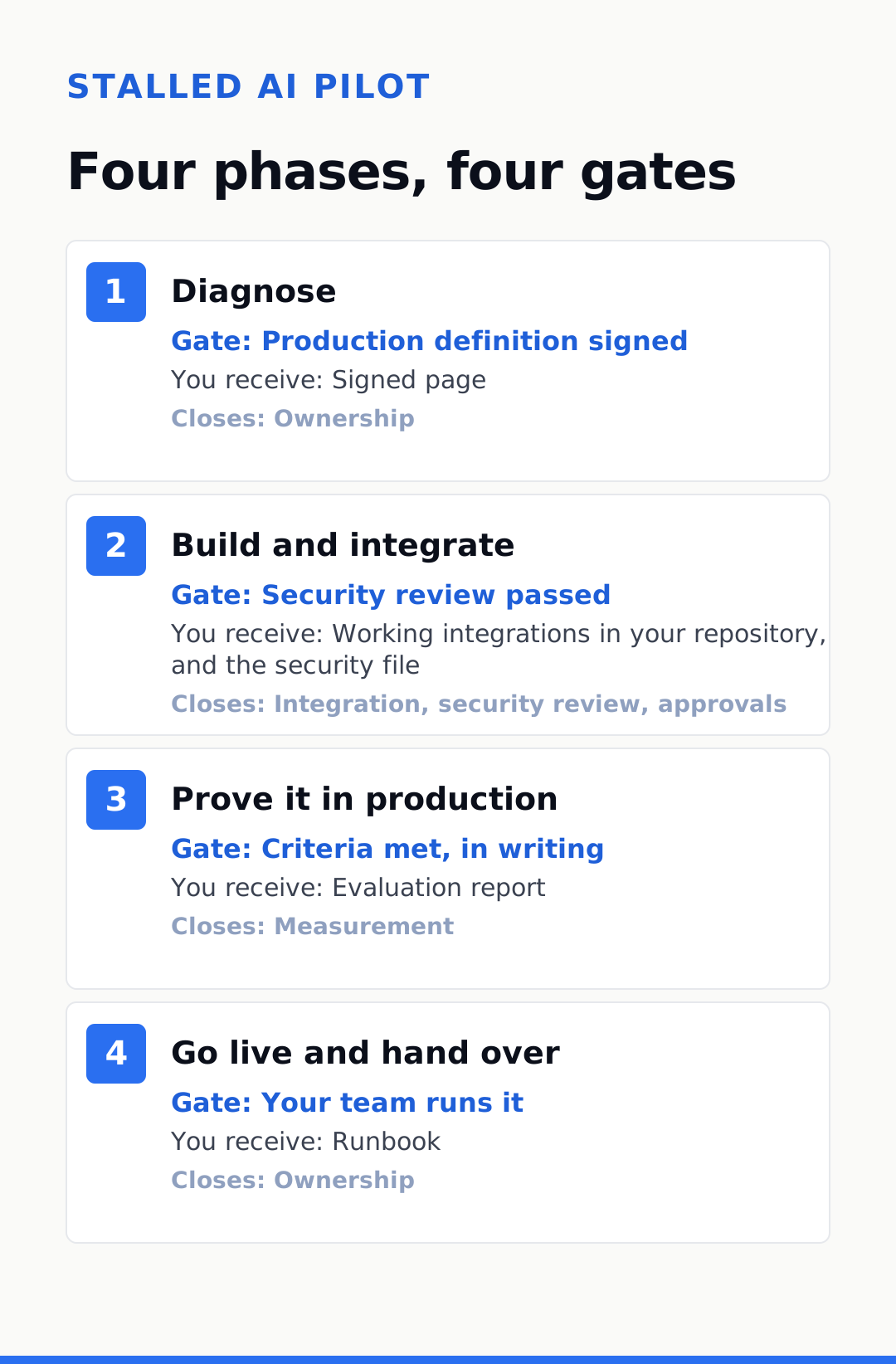
It closes the gap in four phases. Each has one written gate, so you always know where the system stands.
| Phase | What happens | Gate |
|---|---|---|
| 1. Diagnose | Read the pilot, meet the owners, write the production definition | Production definition signed |
| 2. Build and integrate | Integrations, security review and approval path, in your codebase and target environment | Security review passed |
| 3. Prove it in production | The system runs alongside the current process and is measured against the criteria | Criteria met, in writing |
| 4. Go live and hand over | Cut-over, monitoring, runbook and training | Your team runs it |
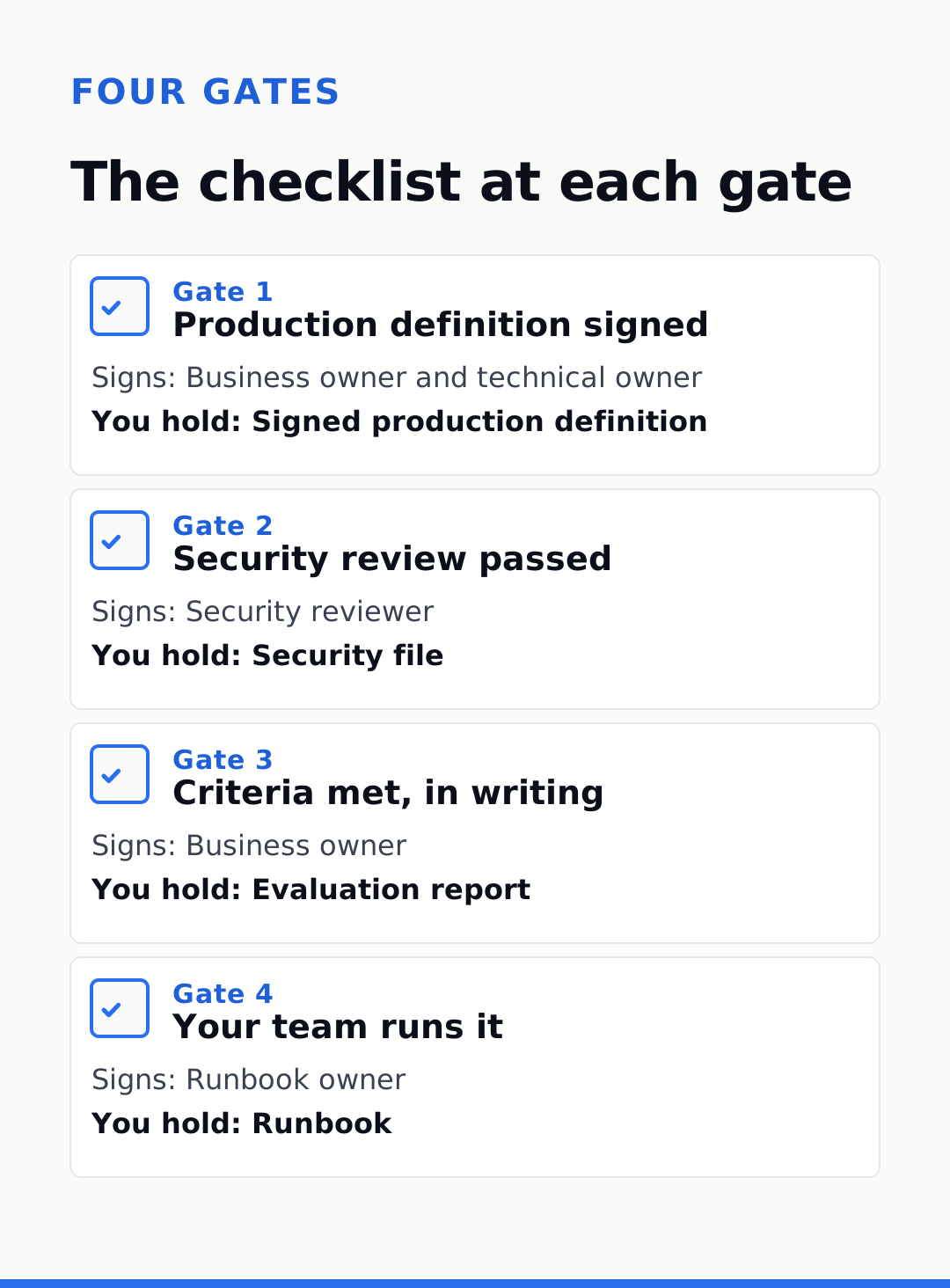
Gate 1 is signed by both owners, gate 2 by a security reviewer, gate 3 by the business owner, gate 4 by the person who runs the runbook.
Phase 1: how does the diagnosis work?
The engineers read the pilot: its code, its data, its environment, how it was tested and what it depends on. They meet the accountable business owner and the accountable technical owner, and they learn how the operation actually runs: who uses the output, what they do with it, and where an error would cost something. Then they write the production definition, one page with the scope, the success criteria, the evaluation set, the security setup, the approvals and the go-live plan.
Gate 1 has two possible outcomes: the owners sign the page, or you receive a written reason why the pilot should not go to production yet. Both are useful. An honest answer early costs far less than a build that stalls again. What the engineer is responsible for at this stage is described in what a forward-deployed engineer is responsible for at the start of an engagement.
Phase 2: what changes when the build happens in your environment?
The work moves to your codebase and your target environment, under the identity, data and security constraints production requires. That removes the classic surprise of a pilot that worked in a separate sandbox and fails on live systems. The security file is prepared alongside the build, because a review that starts at the end is the step that moves the go-live date. For systems that use large language models, the OWASP Top 10 for LLM Applications is a practical checklist for the reviewer.
The approval path is defined here too. The team lists the automated actions where a mistake is costly or hard to undo, and puts approval gates for sensitive automated actions in front of them.
Phase 3: how do you prove it works?
You measure it on live work, against the criteria the owners signed, before anyone switches the old process off. The system runs alongside the current process, and the people who use it see its outputs next to their own work before they rely on them. The NIST AI Risk Management Framework makes measurement one of its four core functions, next to Govern, Map and Manage, and Google’s ML Test Score gives a rubric for testing and monitoring. From that point, an error is a measurement against agreed criteria, not a new debate.
Phase 4: what does handover mean?
The system moves from running alongside the current process to being the process. You receive a runbook, monitoring, training for the people who use it, and a named person on your side who runs it. The test is simple: at the end, your team runs the system. The week-by-week detail is in how a forward-deployed engineering engagement works.
What do you bring, and what do you receive?
| You bring | You receive |
|---|---|
| Two owners who can sign: one for the business, one for the technical system | A signed production definition, or a written reason to wait |
| The pilot as it is: code, prompts, data and the examples it was tried on | Working integrations in your repository |
| Access to the live systems it must reach | A security file and answers to the questionnaire |
| Time with the people who do the work | An evaluation report against agreed criteria |
| A short list of the decisions the system should help with | An approval matrix, and a runbook with a documented handover |
The project-specific code, integrations, evaluation assets and documentation produced are yours.
Should you keep the pilot, rebuild it or wait?
The diagnosis decides, and it decides on what it reads, not on a rule of thumb. The signed production definition states what from the pilot is kept and what is rebuilt. If the page cannot be written, because no owner can sign or the data cannot be reached, the written reason to wait tells you what has to change first.
When does this fit an operator?
It fits when the pilot supports a real decision or process in your operation, when two people can sign for the business and the technology, and when access to the systems can be arranged. If one of those is missing, the first conversation is about getting it in place. When the work is closed and fully known, such as a fixed report or an integration with documented interfaces, a plain specification is efficient, and you do not need this model.
What should you do next?
Bring us the problem, not the specification. You explain the objective once: what the pilot does today, where it needs to run, and what production means for the business. Book a call. One call is enough to know whether we can help. The offer is described on our forward-deployed engineering page.
Questions
- Why do AI pilots stall?
- Usually on decisions, not on the model. Five are common: how the system connects to live systems, who reviews its security, how success is measured, which outputs a person approves, and who owns it after the pilot.
- What can you do with an AI pilot that has stalled?
- Read it as it is, name the open decisions, and write them down on one page that the business owner and the technical owner sign. Then build, prove and hand over against that page. If the page cannot be written, that is a clear answer too.
- Do we have to start over if our AI pilot stalled?
- Not as a starting assumption. The diagnosis reads the pilot, its code, data and tests, before anyone decides what to keep. The result is a signed production definition, or a written reason to wait.
- What do we need to provide for a forward-deployed engagement?
- Two owners who can sign, one for the business and one for the technical system. Access to the pilot as it is. Examples of real cases. Time with the people who do the work.
- What does a forward-deployed engagement answer for?
- Forward-deployed engineering answers for a working system: this system, in your operation, running in production.
- What do you receive at the end?
- A signed production definition, working integrations in your repository, a security file, an evaluation report against agreed criteria, an approval matrix, and a runbook with a documented handover.
Bring us the problem.
Book a call