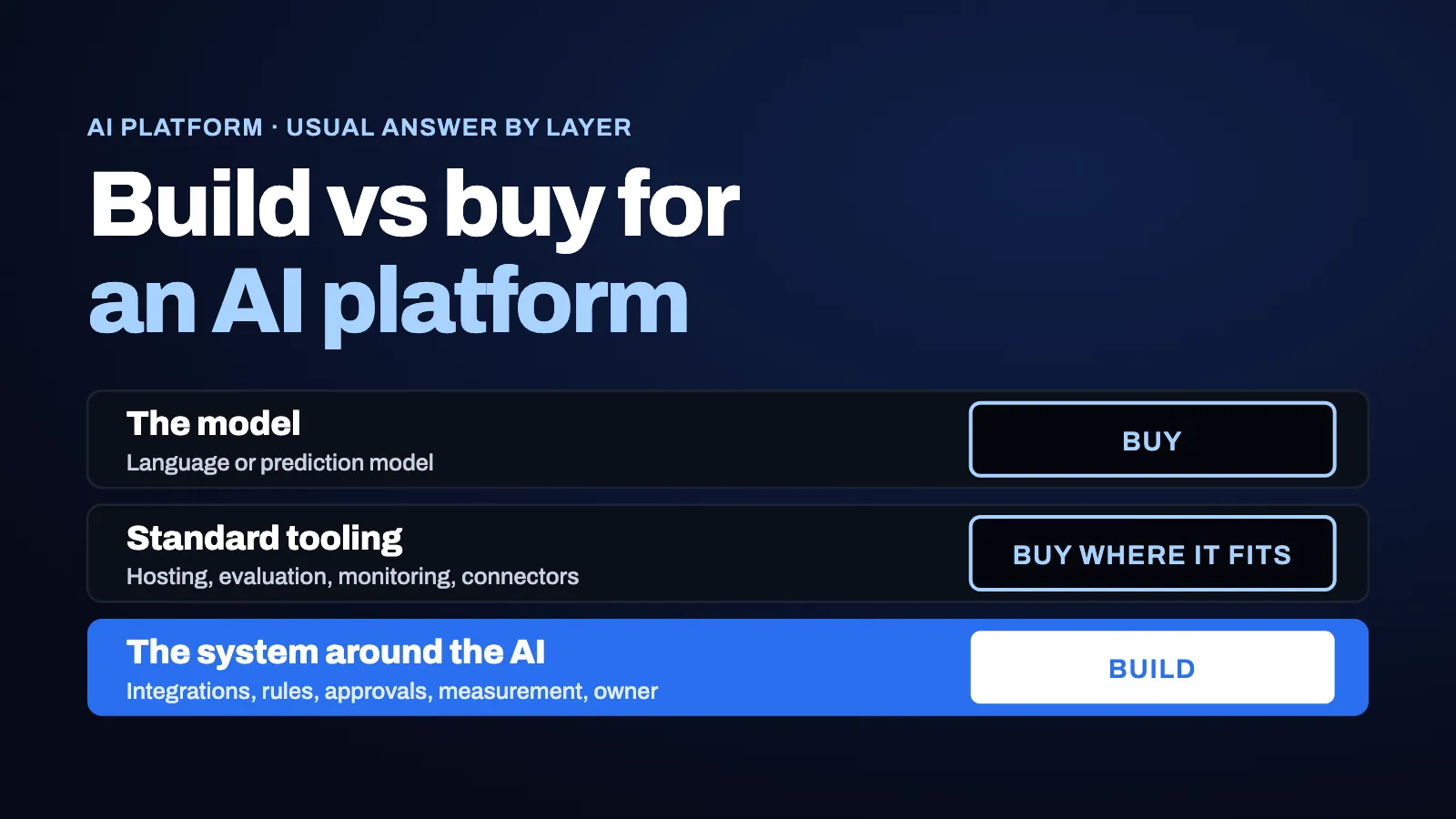
Build vs buy an AI platform comes down to layers: buy what is standard and build the system around the AI where your operation is different. Most operations should not build a model or common tooling. They should build, or have built, the layer that connects the AI to their systems, applies their rules, asks the right person to approve sensitive actions and gives someone ownership. That layer is what we call the system around the AI. When it does not exist, a bought tool or a built pilot tends to stay a pilot.
Build vs buy for an AI platform is a decision about layers: buy the model and the standard tooling, and build the operational system where your process, your rules and your approvals are your own.
This article is for operators with a manual process to improve or an AI pilot to put into production. It gives you the layers, a comparison, the cases where buying wins, and five questions to decide. AI is easy to demo. Production is the hard part, and this choice decides how hard.
Key takeaways
- The choice is per layer, not all or nothing. Models and common tooling are bought. The operational system is where building pays.
- Buy when your process is standard. If a product fits the process as it is, buying is faster and simpler.
- Build when your rules, systems or approvals are your own. That is where a standard tool runs out.
- Ask who owns it in a year. A tool nobody owns fails whether it was bought or built.
What does build vs buy mean for an AI platform?
An AI platform is not one thing. It has at least three layers, and the answer is different for each.
| Layer | What it is | Usual answer |
|---|---|---|
| The model | The language or prediction model that produces outputs | Buy or access as a service. Few operations should build one. |
| Standard tooling | Hosting, evaluation tools, monitoring, common connectors | Buy where a product fits; build only the gaps. |
| The system around the AI | Integrations with your systems, your business rules, approval gates for sensitive automated actions, measurement, a named owner | Build when your operation is specific. This is where the value of your process lives. |
Google engineers made a related point about machine learning in Hidden Technical Debt in Machine Learning Systems (NeurIPS 2015): the model is a small part of a real-world system, and most of the effort and the long-term cost sit in the code and processes around it.
When should you buy an AI platform?
Buy when the process you want to improve is one many other businesses run the same way, and a product already does it. The signs:
- The process is standard. Support ticket triage, meeting notes and similar work look alike across companies.
- Your rules fit the product’s settings. You do not need behavior the product cannot be configured to give.
- The data you need is already in, or easy to send to, the product. Integration is a connector, not a project.
- Speed matters more than fit. A good-enough tool this month beats a perfect one next quarter.
When these hold, buying is the right answer, and building would be a way of spending time. Check the supply side, though: the OWASP guidance on LLM supply chain risk is a useful list for what to ask any provider.
When should you build the system around the AI?
Build when buying leaves a gap that the AI cannot fill alone. The signs:
- Your process runs across several tools and spreadsheets, and the AI would need to read and write in all of them.
- Your rules are specific: pricing exceptions, eligibility, routing, thresholds that only your business has.
- Some actions are sensitive, and a person must approve them before they happen. A standard tool may offer a switch; your approval matrix may need to be a design.
- You need to own the result. Custom code, modules and data stay yours when the platform is built for you.
- The AI has to run inside the operation, not beside it, with measurement and someone responsible for it.
This is the situation in which AI needs the system around it, and we build that too. It is the work behind AI-powered custom platforms, built for your operation.
Build vs buy an AI platform compared
| Buy | Build the system around the AI | |
|---|---|---|
| Time to a first result | Fast, if the process fits | Longer; scope comes first |
| Fit to your process | As good as its settings | Designed for your process |
| Control over changes | The provider’s roadmap | Yours |
| Integration with your systems | Connectors that exist | Built for the systems you run |
| Approvals for sensitive actions | What the product offers | Designed with you |
| Ownership of code and data | License terms | Yours |
| Main risk | The tool does not reach your systems or rules | Nobody owns it after launch |
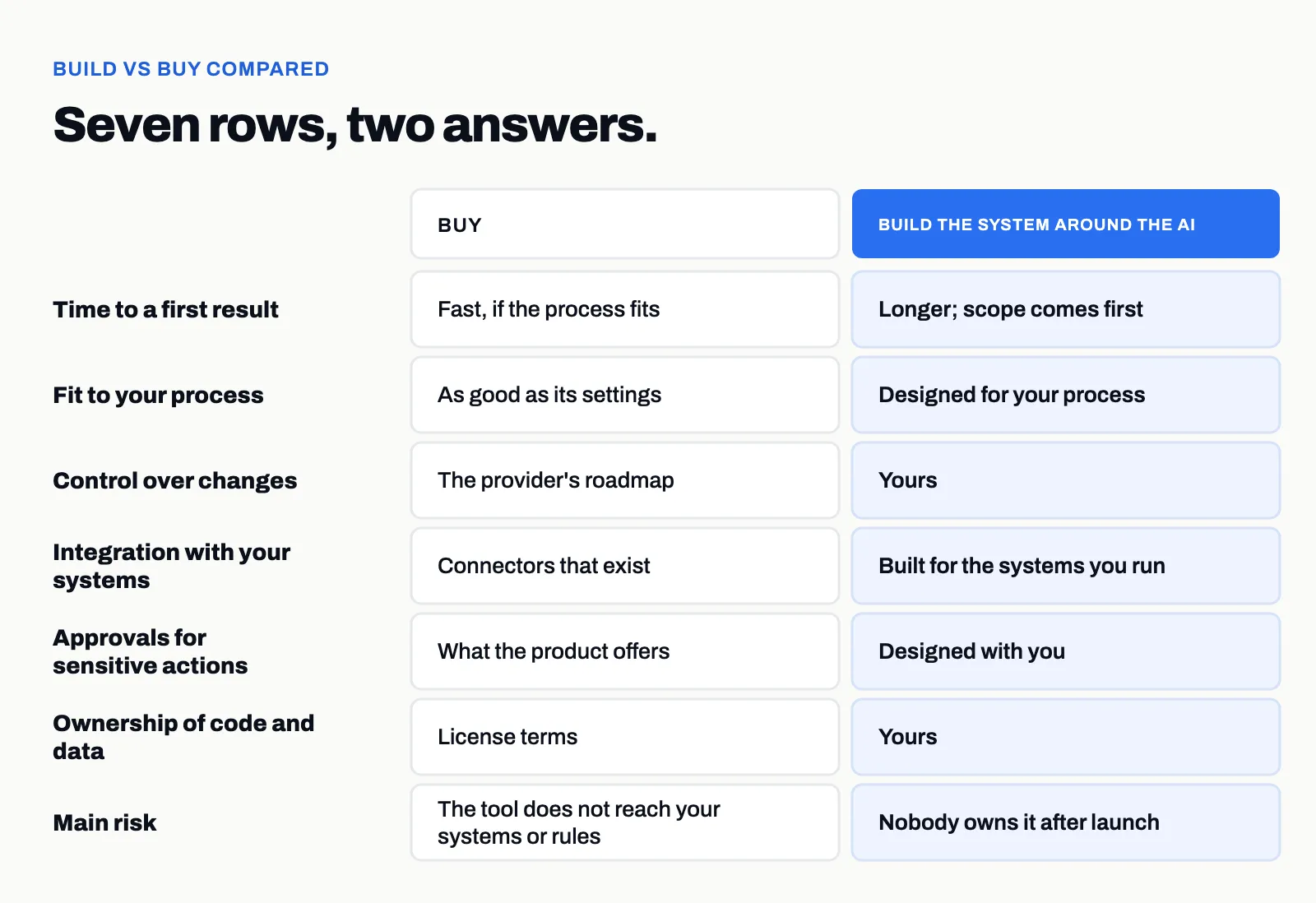
Neither column wins everywhere. Most operations end up with a mix: a bought model and common tools, with a built layer where the process is theirs. The NIST AI Risk Management Framework applies either way, because it asks you to map and manage the risks of third-party components as well as your own.
What is the system around the AI?
It is the part of the platform that makes the AI usable in a real operation. Four pieces:
- Integration. The system reads from and writes to the tools your people already use, with the access production needs.
- Rules and approvals. Your business rules are applied, and sensitive automated actions wait for a person to approve them. See approval gates for sensitive automated actions.
- Measurement. Someone has agreed what good enough means, and the system is tested against it before and after go-live. Google’s MLOps guidance describes this as automation and monitoring around the model, not the model alone.
- Ownership. A named person in your business runs it, and a runbook exists.
These are the same decisions that stall a pilot, described in why AI pilots stall. If any one is missing, buying does not remove it and building does not either. It has to be decided.
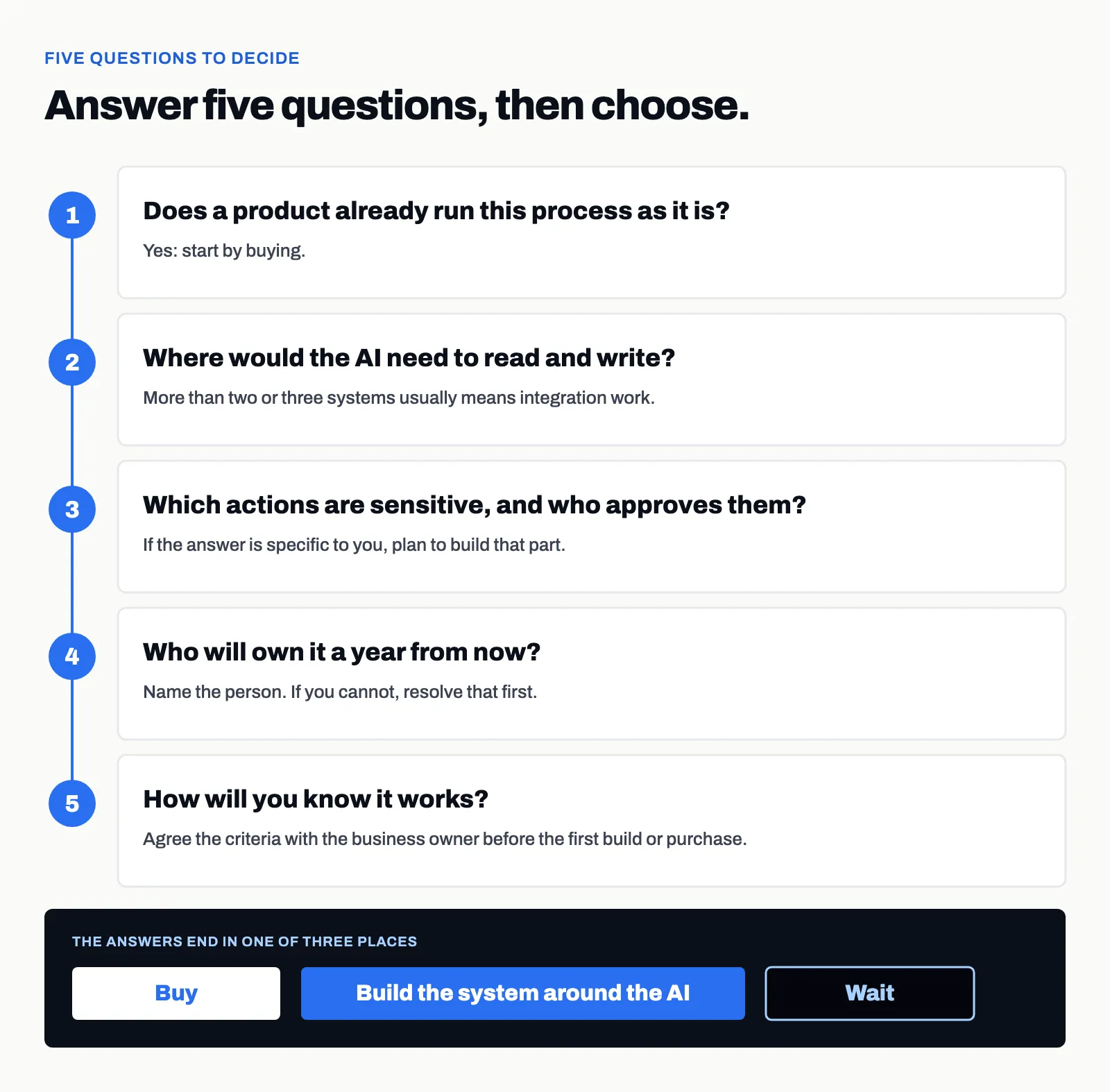
Five questions to decide
Answer these in writing before you choose.
- Does a product already run this process as it is? If yes, start by buying.
- Where would the AI need to read and write? List the systems. More than two or three usually means integration work.
- Which actions are sensitive, and who approves them? If the answer is specific to you, plan to build that part.
- Who will own it a year from now? Name the person. If you cannot, resolve that first.
- How will you know it works? Agree the criteria with the business owner before the first build or purchase.
The page that holds these answers is the one that defines production for the system, covered in what production means for an AI system. The AI production readiness checklist turns them into 25 questions.
What does a wrong choice cost?
Two failure modes. A bought tool that cannot reach your systems or follow your rules becomes a second place where people do the work, and the spreadsheet stays. A built system that nobody owns after launch drifts away from the process it was meant to serve. The first is a fit problem. The second is an ownership problem. Both are visible in the five questions above, before anything is spent.
When should you wait?
If no one can sign for the business and for the technology, if the process changes every month, or if you cannot get access to the systems the AI has to use, neither buying nor building will hold. The first step is to get those in place. An honest answer early is cheaper than a project that stalls.
What should you do next?
Take one process and answer the five questions. If the answer is to build, we start with a fixed scope, a fixed price and a named senior lead.
Bring us the problem, not the specification. Book a call. One call is enough to know whether we can help.
Questions
- Should I build or buy an AI platform?
- Buy what is standard: models and common tooling. Build the system around the AI where your operation differs: your rules, your systems, your approvals. Most operations end up doing both.
- What is the difference between building and buying AI?
- Buying means using software someone else built for many customers. Building means a system made for your operation. The difference is how well it fits your process, who controls changes, and who owns the result.
- Is a hybrid approach better?
- Usually, yes. Few operations build their own model. The real decision is which layer above the model you need to own.
- When does buying AI software fail?
- When the tool cannot reach the systems your work runs in, when your approval rules do not fit its settings, or when nobody in your business owns it after the first weeks.
- Who owns the code and data when a platform is built for you?
- In a platform build with us, your custom code, modules and data stay yours.
- How do I know my operation needs a custom platform?
- When the process runs across several tools and spreadsheets, when your rules are specific to you, and when AI has to act inside that process with approvals. If a standard tool covers the process as it is, buy it.
Bring us the problem.
Book a call