
Your staff built a tool because no vendor would fix the workflow. It works. If someone is now using this AI-built tool with patient data, the next question matters.
The Medical Group Management Association (MGMA) wrote in September 2026: “Practices run on highly specific workflows that no vendor has a business case to fix.” In a September 2026 MGMA Stat poll with 228 responses, about 34% said their practice had built its own app or workflow tool in-house using AI. MGMA gives no margin of error or sample design for the poll, so read it as a signal, not a share of all groups.
Here is the question to ask about AI-built tools and patient data before the next one goes live: what can a stranger read, and who signs go or hold?
Key takeaways
- The first test needs no code. A private window, no sign-in, look at what loads.
- The risk comes from settings nobody reviewed. Not from the idea of building.
- Go-live is a decision with two named owners. One for the business, one for the checks.
- Surveys are a reason to look. Not a rate for your group.
What leaders report
In a July 2026 survey of 151 healthcare leaders, 70% said they had found an AI-built tool that handled patient data without IT or security knowing. Every respondent already uses AI coding assistants and handles patient data, 63% work in hospitals or health systems, and the margin of error is plus or minus 8%. Most respondents (77%) were IT or security leaders, not multi-site medical group managers. The survey was run by Paubox, an email security vendor, and it does not show what caused the finding.
Read it as a reason to look, not as a rate for your group.
AI-built tools and patient data: what a stranger could reach
Crissy Field GmbH, an application security firm, analysed 159,041 projects built with one AI app-building tool between December 2025 and September 2026. Of the 34,545 that used an online database service, 24,664 sent database records as soon as the page loaded, with no sign-in. Crissy Field says that this alone is not a security issue, because the data may be intended for public display, and that its sample is not representative. The figures come from its research page.
Your group may not use that tool. The point is how easily one setting can leave data readable.
A public case
In July 2025 the HHS Office for Civil Rights announced a settlement with Deer Oaks, The Behavioral Health Solution, resolving potential HIPAA violations (HHS press release, 7 July 2025). The agreement states that it is not an admission of liability by Deer Oaks. The settlement covers two matters. First, discharge summaries of 35 people were searchable online from at least December 2021 until 19 May 2023; according to Deer Oaks, a coding error in a discontinued patient-portal pilot caused it. Second, an August 2023 ransomware breach for which 171,871 people were notified. The Office for Civil Rights found a failure to conduct an accurate and thorough risk analysis. Deer Oaks paid $225,000 and agreed to a two-year corrective action plan. Secondary report: Hunton.
This was not an AI-built app, and we know of no public case of an AI-built app exposing a medical group’s patient data. What it has in common with the tools in this article is a pilot that patient data could still reach from the open internet.
The first test needs no code
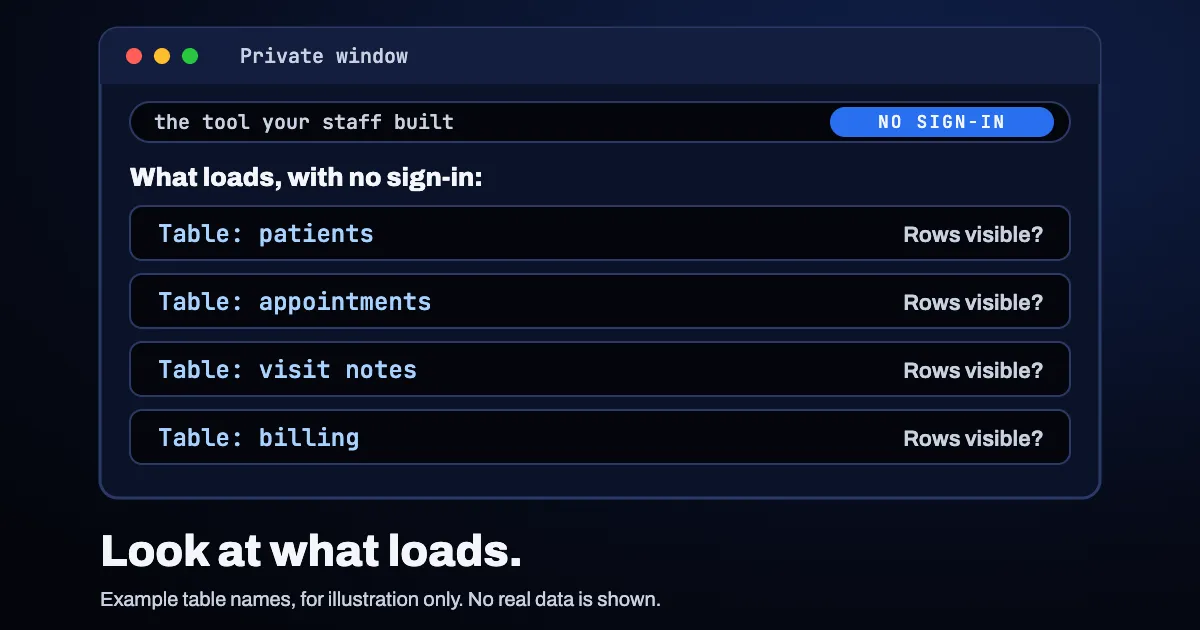
Open the tool in a private browser window without signing in. Look at what loads.
Then ask the person who built it what a request with no sign-in returns for each table of patient data. You do not need to read code for the first test. You need to hear whether the answer is clear. The general version is the go-live review for an AI-built app.
Five checks for an AI-built tool that touches patient data
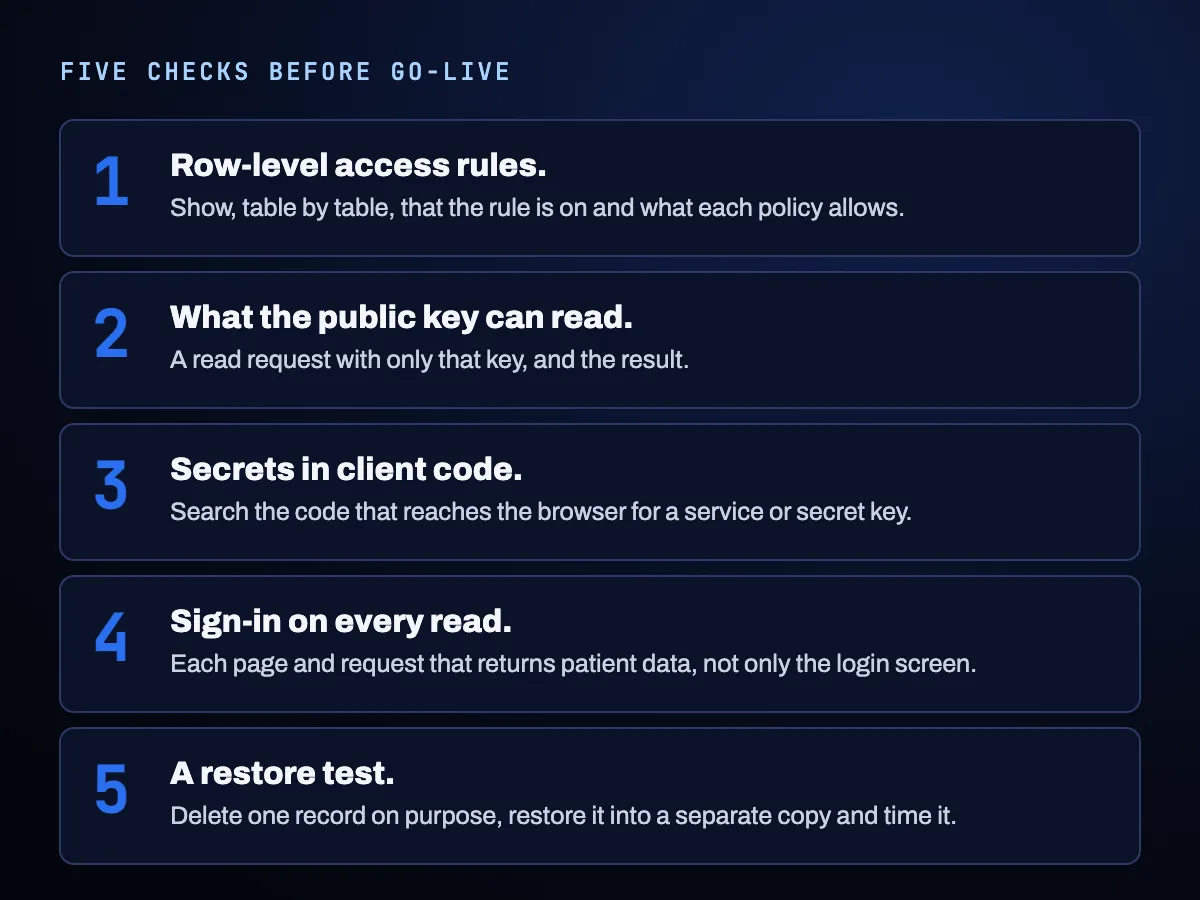
- Row-level access rules. Ask the builder to show, table by table, that the rule is on and what each policy allows.
- What the public key can read. Ask for a read request with only that key and the result. It should return nothing a visitor should not see.
- Secrets in client code. Search the code that reaches the browser for any key marked as a service or secret key.
- Sign-in on every read. Check each page and each request that returns patient data, not only the login screen.
- A restore test. Delete one record on purpose, restore it into a separate copy and time it.
For the wider set of checks on AI-written code, see how to check the quality of AI-generated code.
Two named owners sign go or hold
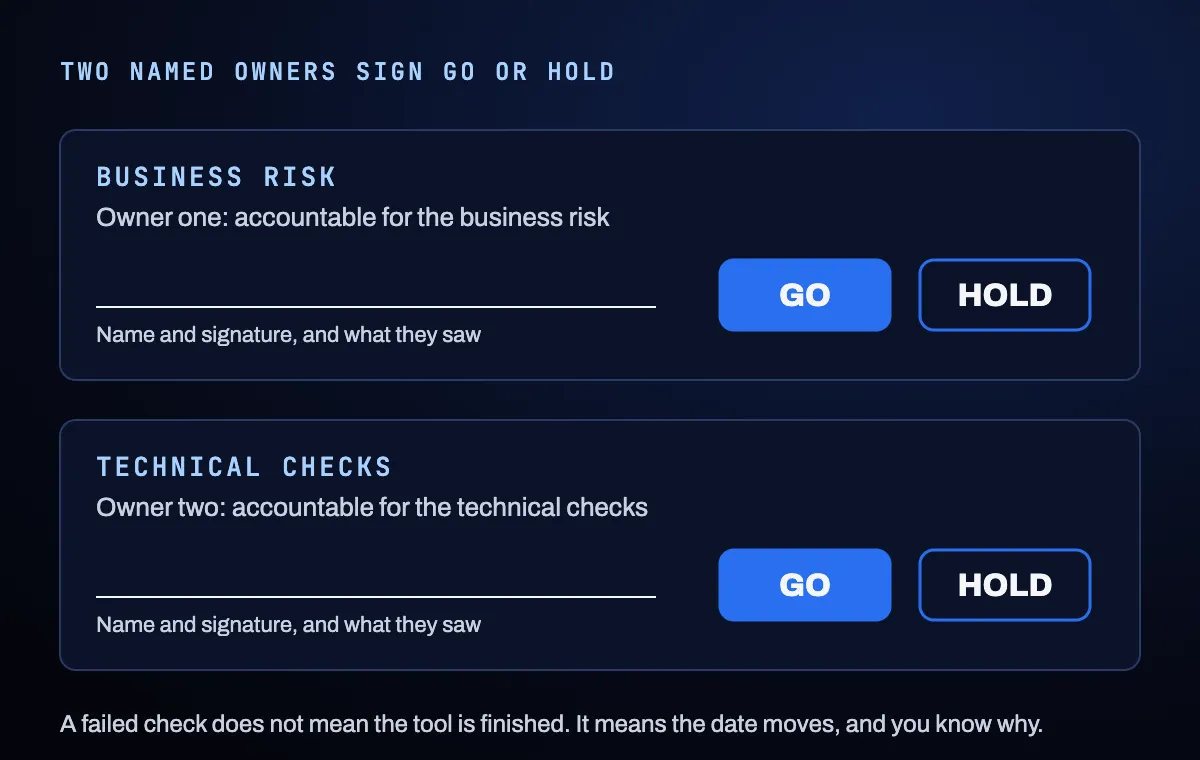
Write the result on one page. Name two owners: one accountable for the business risk, one for the technical checks. Each states in writing what they saw. A failed check does not mean the tool is finished. It means the date moves, and you know why. Define production before anyone signs.
The notice rule and the cost
Under the HIPAA Breach Notification Rule, a covered entity must notify affected individuals without unreasonable delay and no later than 60 calendar days after discovery of a breach of unsecured protected health information (45 CFR 164.404(b)). The rule treats a breach as discovered on the first day it is known to the covered entity or, by exercising reasonable diligence, would have been known. The knowledge of a workforce member or agent of the covered entity counts, other than the person committing the breach (164.404(a)(2)). Read the rule on eCFR, current as of 18 November 2026, or on Cornell LII. This is not legal advice. Ask your counsel what applies to you.
IBM’s 2026 report, as reported by HIPAA Journal and Chief Healthcare Executive, puts the average healthcare data breach at $6.64 million, down from $7.42 million in 2025. It is an average across organizations. It is not a forecast for your group.
Where OrNsoft fits
Bring us the problem. We move the system from concept or pilot to production. If a tool your staff built is close to going live with patient data, bring us the problem. See also the AI production readiness checklist.
Sources and method
- MGMA Stat, “Would you vibe code an EHR with AI”, poll of 22 September 2026: mgma.com
- Paubox, 2026 CISO’s Guide to Healthcare AI Governance, July 2026: paubox.com
- Crissy Field GmbH, research page: crissyfield.de
- HHS Office for Civil Rights, press release, 7 July 2025: hhs.gov (archived copy: web.archive.org)
- HIPAA Journal, 8 July 2025.
- Hunton, 15 July 2025: hunton.com
- 45 CFR 164.404, eCFR, as of 18 November 2026: ecfr.gov; Cornell LII: law.cornell.edu
- IBM Cost of a Data Breach Report 2026, as reported by HIPAA Journal (29 July 2026) and Chief Healthcare Executive (31 July 2026; 2025 figure, 30 July 2025).
Questions
- What can a stranger read in a tool my staff built with AI?
- Test it: open the tool in a private browser window without signing in and look at what loads, then ask the builder what a request with no sign-in returns for each table of patient data.
- What are the five checks before go-live?
- Row-level access rules, what the public key can read, secrets in client code, sign-in on every read, and a restore test.
- Who signs go or hold?
- Two named owners: one accountable for the business risk, one for the technical checks. Each states in writing what they saw.
- How long does a medical group have to notify patients of a breach?
- Without unreasonable delay and no later than 60 calendar days after discovery of a breach of unsecured protected health information (45 CFR 164.404(b)). This is not legal advice; ask your counsel what applies to you.
- Has an AI-built app exposed a medical group's patient data in public?
- The article knows of no public case. The Deer Oaks settlement it cites was not an AI-built app; what it shares with these tools is a pilot that patient data could still reach from the open internet.
Bring us the problem.
Book a call